
Counters in local government offices are seeing their “writing desks” disappear. The movement towards “no-writing counters,” where the desks and pens for handwritten application forms are being removed in favor of digital device input, is spreading nationwide. This news highlights a fundamental challenge many companies face in their Digital Transformation (DX) efforts, going beyond mere administrative efficiency. It reveals a structure where the introduction of technology itself becomes the goal, while the crucial “redesign of work processes” is left behind.
Rediscovering Business Processes Beyond “Not Writing”
The essence of the “no-writing counter” is not simply replacing paper with digital. It is an opportunity to fundamentally review the entire counter service process from the perspectives of both users and staff. Traditionally, applicants struggled with complex paper forms, while counter staff spent significant time on the “unproductive task of checking” for errors or omissions and requesting resubmission.
Digitization enables real-time input assistance and validation (input checks) by the system. This allows staff duties to shift from “document checking” to “substantive consultation and support regarding application content.” The key point here is that tools (digital devices) do not change the work; meaning is only born from the tools when there is a desired future state for the work (the shift in where staff create value).
The Pervasive Illusion in Corporate DX: “Using AI = DX”
This structure perfectly aligns with the problem pointed out in the ITmedia survey introduced earlier: “IT Departments Struggling with Management’s Misconception that ‘AI Use = DX’.” Many executives mistakenly view the introduction of generative AI, like ChatGPT, as the goal of DX itself. However, AI is merely a tool. Without a blueprint for which tasks to use it for, whose burden to reduce, and what new value to create, it ends up as just a “costly toy.”
IT departments are frustrated because while they often receive directives from management to “just introduce AI,” there is frequently a lack of concrete strategic discussion on “which existing business processes have issues and how AI will improve them.” This is akin to a local government saying “just deploy tablets” without envisioning “the new counter service model that comes after removing the writing desks.”
The Split in Objectives: The Disconnect Between Business IT and Operational IT
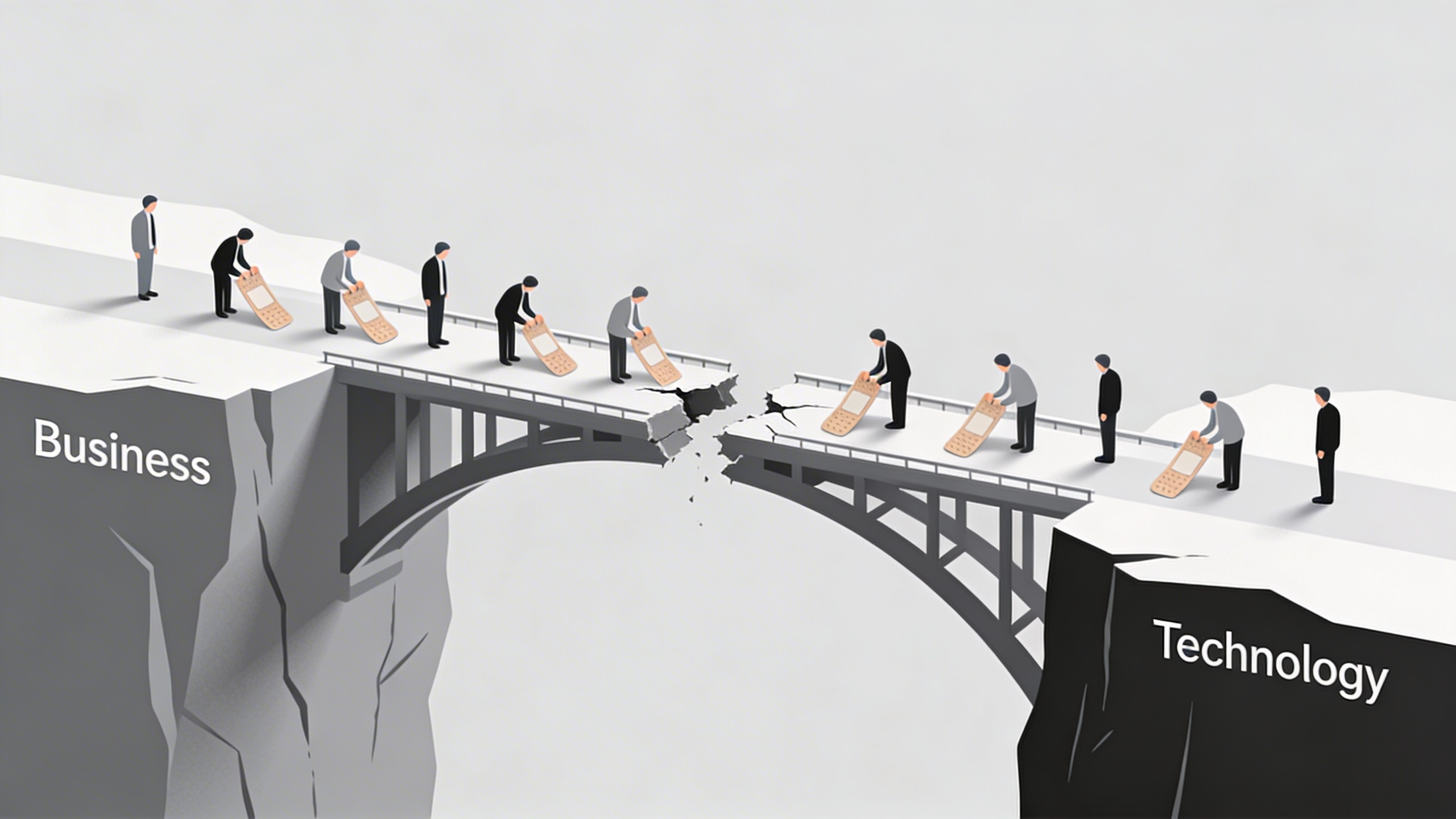
What this media outlet repeatedly points out as the “split in objectives” is occurring here. There is no common goal or evaluation criteria between the “AI-driven transformation (a Business IT growth image)” expected by management and the reality of the IT department (a Management IT stability image) responsible for operational efficiency and risk management.
A typical pattern for failed AI implementation projects is the absence of a “translator” or “designer” to bridge this split. The work of translating management’s desired business outcomes into concrete business processes, data flows, and appropriate technical tools is missing.
How “Buildee Digital KY” Shows the “Correct Order for Digitization”
The release news for “Buildee Digital KY,” which digitizes hazard prediction activities (KY) on construction sites, shows one answer. KY activities are originally a dialogue process to share on-site risks and enhance safety. However, a challenge existed where filling out and managing paper KY sheets became the goal itself, leading to a hollowing-out of the process.
This tool did not simply turn a paper form into an app. It clearly charts a path to the next value creation by enabling easy input and sharing on-site and allowing accumulated data to be analyzed, leading to improved safety education quality and trend analysis of hazardous locations. The premise for introducing the tool is the process redesign perspective of “returning to the essence of hollowed-out work.”
What Leaders Must Ask: “Digitization for What Purpose?”
When executives or DX leaders receive proposals for new tools or AI, the first questions they should ask are like the following:
- Which part of which current business process does this tool/AI solve a problem for?
- Specifically, how will employees’ work content and time allocation change after introduction?
- How is it designed to redirect the surplus time and resources created toward what kind of higher-level work (value-creating activities)?
- How will the outcomes of that new work be measured?
For a “no-writing counter,” the answer is not “we removed the writing desk and gave them a tablet,” but must be “we reduced the time counter staff spend checking documents and allocated that time to consulting on complex cases, thereby improving citizen satisfaction.”
The Hint for Companies in Nation-Led Digital Infrastructure
The reason news about municipal DX calls for “nation-led development of digital infrastructure” is that if individual municipalities develop systems separately, data linkage and public convenience cannot be achieved. This mirrors the “silo” problem within companies.
The proliferation of department-optimized SaaS applications, with data scattered and unusable for management decisions, is precisely a lack of “common infrastructure.” Before making decisions on individual tool introductions, management must strategically define the form of an “internal digital infrastructure” where data is integrated and can be analyzed cross-functionally. Only when this foundation is in place can individual AI tools link organically, enabling truly data-driven management.
Practical Steps: Starting DX with Process Visualization
So, what concrete measures can you start with? There are things you can do before large-scale investment.
- Identifying “Hollowed-Out Work”: Ask each department to identify tasks they perform while feeling they are meaningless or “input for the sake of input.” This includes paper-based approvals, manual Excel aggregation, dual entry into multiple systems, etc.
- Visualizing the Process: Diagram all steps from start to finish of that task, separating value-adding work from non-value-adding work (movement, checking, waiting, correction). Focus on human actions and decisions, not IT tool screen transitions.
- Discussing the “Ideal State”: Discuss the ideal workflow and clarify the factors preventing its realization (rules, system constraints, customs).
- Defining Tool Requirements: Only then, define the functions required in tools or AI to realize the ideal process, using “the language of the business.” This requirements document becomes the common language for equal discussion with IT or vendors.
The “no-writing counter” is merely one form resulting from the government practicing this process.
Conclusion: DX is Not Technology, But Management Will
The removal of writing desks in municipalities and the missteps in corporate AI adoption grow from the same root. It is a mental shortcut that assumes “introducing the means” equals “achieving the goal”. The essence of DX is not the cloud or AI; it is the “management will and capability” to continuously redesign an organization’s business processes and the arenas where its talent creates value in an era of rapid change.
Executives, CTOs, and IT managers: the next time new technology is discussed, first ask yourselves, “Which of our company’s ‘writing desks’ is this meant to remove, and what is it meant to change them into?” Within that answer, the path to the true DX that becomes a source of competitiveness will surely become visible.

Comments