Last week, two seemingly unrelated news stories were reported. One was the official launch of “TRASS,” an AI SaaS specialized for infrastructure inspection. The other was news that Infomart opened a new base in Fukuoka specializing in “invoice digitization.”
The former involves cutting-edge “AI” technology; the latter is the unglamorous foundational work of “digitization.” Many managers tend to be captivated by the “flashiness” of the former and dismiss the latter as “subcontractor work.” However, placing these two news items side by side reveals the “essential order” that managers most often misjudge, yet must decide upon, for the success of digitalization or DX.
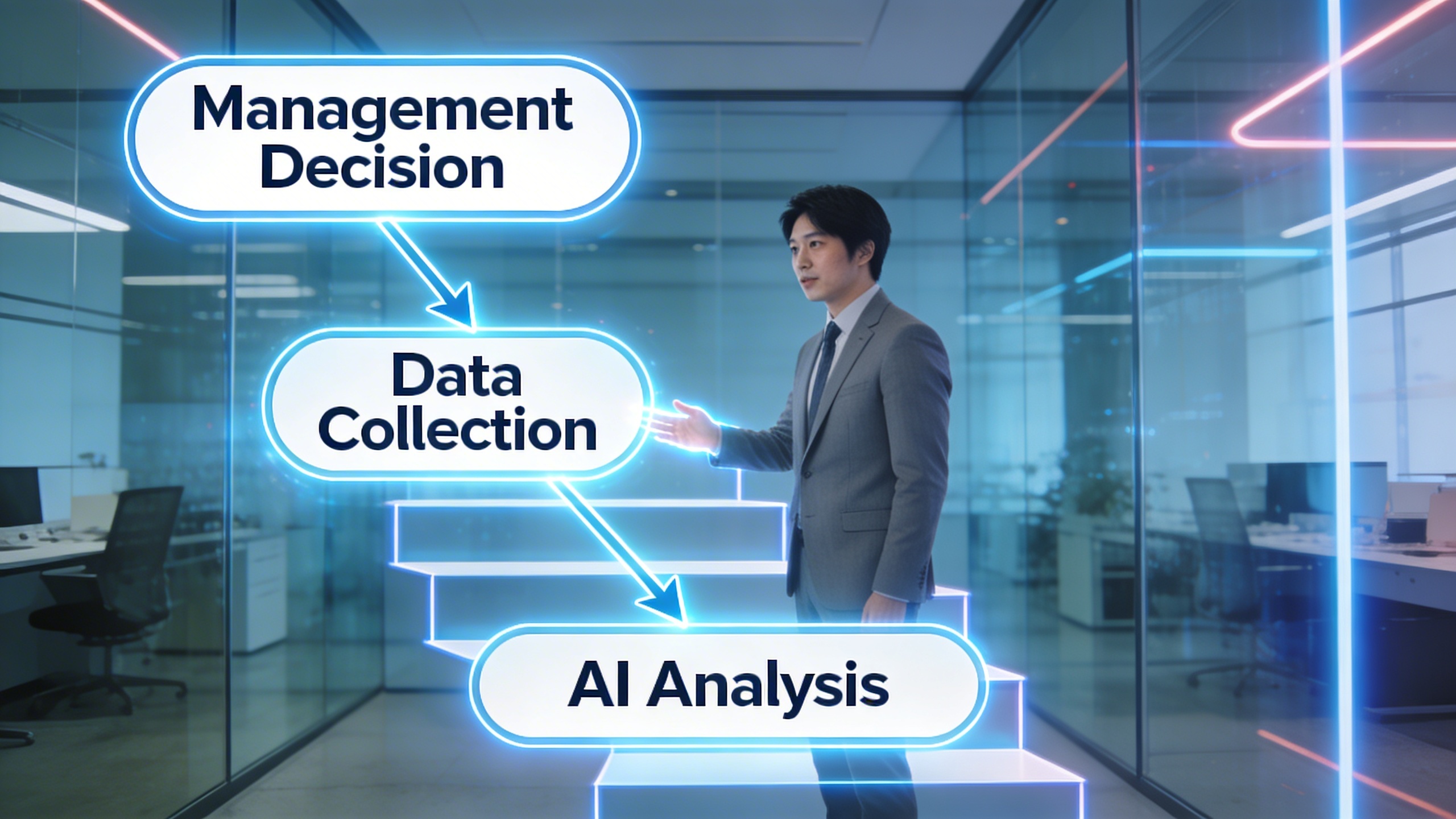
That order is: first, clearly define the objective of “enhancing the reproducibility of management decisions,” then design “data collection” for that purpose, and only then do “advanced analysis and AI” become meaningful. Getting the order wrong turns AI into merely an “expensive toy” and digitization into a “costly chore.”
- Deciphering the “Two-Layer Structure” from the News: The Data Foundation and the AI Roof
- The “Dark Side of Digitization” When Management Abdicates Definition: 3 Typical Failure Patterns
- Digitization as “Management IT”: Designing Decision Reproducibility
- Practical Steps: How Management Should Lead in Determining the “Order of Digitalization”
- Conclusion: Digitization and AI are the “Reproducibility Engine” for Management Decisions
Deciphering the “Two-Layer Structure” from the News: The Data Foundation and the AI Roof
First, let’s organize the two news items from a “Management x IT” perspective.
1. Infomart’s “Digitalization Promotion Center”: This is an initiative to strengthen the “data foundation”—converting analog invoices into digital data—by establishing a specialized base. It is the work of organizing invoices, the most critical documents recording “transaction decisions (who to pay and how much),” into a searchable, aggregatable, and analyzable form. It’s unglamorous but is the starting point for all management analysis.
2. Infrastructure Inspection AI “TRASS”: This represents the “analysis and decision-support roof,” where AI analyzes image data obtained from inspection tasks to detect deterioration or abnormalities. It has demonstrated “improved operational efficiency and inspection quality” in proof-of-concept trials. This is a tool that supports decisions regarding “equipment maintenance (whether to repair or leave as is).”
The crucial point here is that the premise for “TRASS” to be effective is an environment where the inspection task is established and “data” like images are continuously collected. AI can only enhance the “quality and speed of decisions” on top of that foundation.
Many companies fail at DX because they invest only in this “roof (AI and analysis)” while the “foundation (digitization)” remains weak, or they start collecting data without a clear purpose. Managers have the responsibility to define which foundation (data) to solidify, and in what order, to enhance their company’s “decision reproducibility.”
The “Dark Side of Digitization” When Management Abdicates Definition: 3 Typical Failure Patterns
Even if they intellectually understand that “digitization is important,” when management fails to define its purpose and order, the frontline falls into the following “dark patterns.”
1. Aimless Data Collection: The Trap of “Digitizing for the Sake of It”
The directive to “digitize” comes first, leading to simply converting paper documents into PDFs and dumping them on a server. This creates mountains of mere “digital garbage” that cannot be searched or aggregated. Infomart specializes in invoices precisely because they are directly linked to clear management decisions like “payment management,” “supplier analysis,” and “cash flow forecasting.” Management must first ask, “Which decision do we want to improve, and how, through this digitization?”
2. Departmental Optimization: The Birth of Data “Dialects”
Sales manages customer data in Salesforce, accounting manages transaction data in accounting software, and manufacturing manages production data in another system. “Efficiency” may improve within each department. However, unless management defines “common data items and formats for company-wide decision-making,” this data scatters as incompatible “dialects.” The result is a state where even “average customer value for the entire company” cannot be easily calculated.
3. Leaving Human Judgment Tacit Before AI Introduction
For inspection AI like “TRASS” to be effective, there is a prerequisite that the “know-how of skilled technicians” has been somewhat formalized (manualized). AI learns from and extends that formalized knowledge. However, if inspection criteria rely entirely on an inspector’s “intuition and experience” and remain tacit, the very “training data” needed for the AI cannot be created. Before introducing AI, management should define the effort to codify human judgment into a “reproducible process and criteria.”
Digitization as “Management IT”: Designing Decision Reproducibility
Here, recall the “Three IT Classifications” from our editorial policy. These two news stories are precisely about the core of “Management IT.”
Management IT is IT that ensures decision-making and its reproducibility. Infomart’s invoice digitization enhances the transparency and traceability of “payment decisions,” making past decisions analyzable. Inspection AI enhances the quality and speed of “equipment investment/maintenance decisions,” supporting the standardization (reproducibility) of judgment criteria.
What managers must do is clearly define the purpose of this “Management IT,” without confusing it with “Administrative IT” (cost reduction, stable operation) or “Business IT” (speed of sales expansion). When starting a digitization project, managers should be able to answer the following questions:
- Which “management decision” (e.g., investment decision, personnel evaluation, pricing) are we improving through this digitization?
- Does that decision currently rely on individual experience or intuition?
- After digitization, how will we analyze that data, and how and in which meetings will we use it? (Designing the output)
Failing to debate these questions in management meetings and delegating “just go ahead and digitize” to the IT department or frontline is tantamount to “abdicating” the definition of purpose.
Practical Steps: How Management Should Lead in Determining the “Order of Digitalization”
So, what should you start with concretely? Before a large-scale DX project, have the management team discuss the following three steps.
Step 1: Identify One “Management Decision” That is Both Highly Tacit and Critical
Examples include “Go/No-Go decision for a new business,” “Resource allocation to key customers,” or “Decision on timing to replace used equipment.” Identify decisions where numbers and experience are mixed and which depend on specific key persons. The “repair decision” in infrastructure inspection is a classic example.
Step 2: Design the “Minimum Necessary Data Items” and “Acquisition Methods” for That Decision
What data is absolutely essential to enhance the reproducibility of that decision? Where and in what format does it currently exist? Using Infomart’s case as an example, design how to reliably collect invoice data necessary for “payment decisions” in an analyzable form. At this stage, options like introducing cloud invoice receipt services (such as Freee or Money Forward Cloud Invoice) or outsourcing to specialized services like Infomart come into consideration.
Step 3: Visualize the Data Analysis and Decision Process, and Create an Improvement Cycle
Visualize the decision process based on the collected data. Excel or BI tools (Tableau, Power BI) are sufficient at first. Only at this point does the discussion, “Is AI (like TRASS) or advanced analysis effective for making this decision faster and more accurately?” become meaningful. AI is merely a “means” to strengthen part of this established “data → analysis → decision” cycle.
Conclusion: Digitization and AI are the “Reproducibility Engine” for Management Decisions
The news about infrastructure inspection AI and the invoice digitization center symbolizes the two wheels of digitalization. However, their essence lies not in the technology itself, but in the fact that IT can now support the fundamental managerial task of “embedding the reproducible element of data into the uncertain act of management decision-making, and accumulating and refining it as an organizational asset.”
As long as managers think “digitization is a hassle” or “let the experts handle AI,” IT investment will remain a cost center. Conversely, defining what your company’s core decisions are, what data foundation is needed to enhance their reproducibility, and deciding the order of its development is the best management decision.
Digitalization is a perfect opportunity to confront the deferred cost of “tacit decision-making” that management has avoided, and to elevate the company from “human intuition and experience” to “organizational intelligence.”


Comments