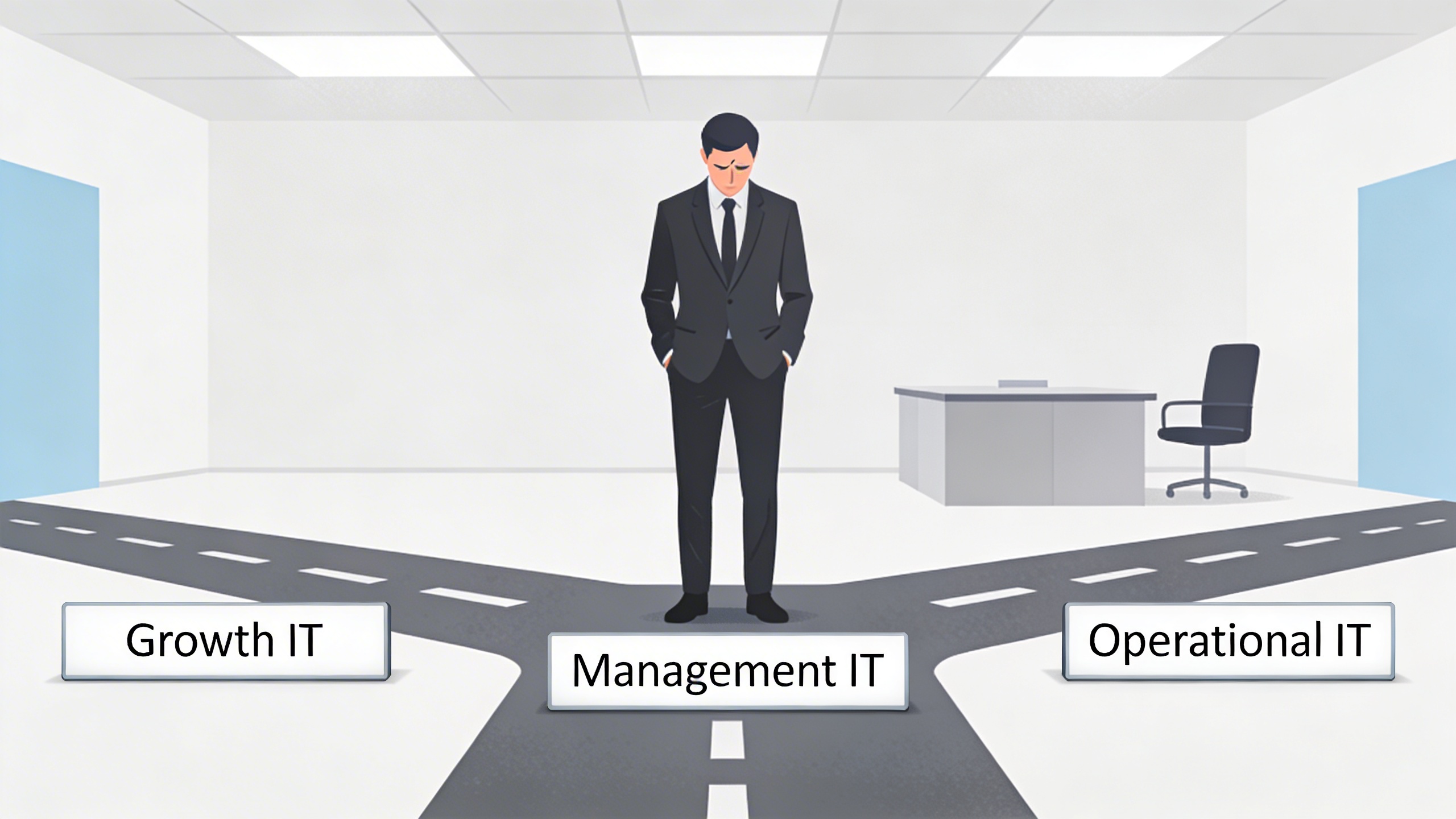
- The Moment “Leaving IT to the Experts” Becomes Management Abdication
- The Disconnect of Three ITs Created by “Leaving It to Others”
- The Concrete Costs of Decision-Making Paralysis: A Case Study of a Mid-Sized Company
- The First Step in “IT Definition” Management Can Start Today
- For Management to “Delegate” to Experts, It Must First “Define”
The Moment “Leaving IT to the Experts” Becomes Management Abdication
“We leave IT to the experts.”
When a manager utters these words, a precarious boundary between “delegation” and “abdication” exists. Many managers have viewed IT as a complex, specialized “technical domain” and removed it from their scope of judgment. However, this act is not merely a division of labor; it means outsourcing the very “design of decision-making” that is fundamental to the business.
What happens as a result? The purpose of IT becomes fragmented across departments. The “Business IT” that supports growth, the “Management IT” that supports executive decisions, and the “Operational IT” responsible for stable operations evolve separately without a common goal. This is the root cause of SaaS sprawl without data integration, unclear return on investment, and increasing reliance on specific individuals. The price management pays for turning a blind eye to IT inevitably returns in the form of lost business reproducibility and scalability.
The Disconnect of Three ITs Created by “Leaving It to Others”
When management does not define the purpose of IT, three types of IT develop independently within the organization. Because each has a different “master” and “success criteria,” integration becomes fundamentally difficult.
“Business IT” Driven Solely by Speed
The sales department implements Salesforce, marketing implements HubSpot. These have clear objectives (objective functions) like “immediate sales” or “lead generation.” The criteria for judgment are “speed” and “immediate results.” Without management intervention, each department adds tools solely to achieve its own KPIs, leading to data silos (isolation). In one retail company, the e-commerce, store, and CRM departments each operated separate customer databases, resulting in situations where different promotions were sent to the same customer.
“Management IT” That Fails to Design Reproducibility
The data needed for management decisions is scattered across disparate Business IT systems. Monthly financial figures are in accounting software (e.g., Freee), sales details in Salesforce, web ad effectiveness in Google Analytics. Even if management wants to “see overall company performance at a glance,” no one has designed the “Management IT” to integrate these. As a result, reports for executives are manually compiled in Excel, creating “shadow work” known only to the employee who created it. This is the result of management itself abandoning a reproducible foundation for decision-making.
“Operational IT” Where Only Stability is Valued
In many companies, the IT department is placed under administration or accounting. Its primary mission is “cost reduction” and “stable operation.” The main evaluation criteria are that the network doesn’t go down and security incidents don’t occur. Consequently, IT departments tend to be hesitant about introducing new, potentially risky Business IT tools. An IT manager at a manufacturing company confessed, “I get more credit for having zero failures in existing systems than for proposing new cloud tool introductions.” Here, “contribution to growth” is not included in the evaluation metrics.
The Concrete Costs of Decision-Making Paralysis: A Case Study of a Mid-Sized Company
What costs actually arise from “leaving IT to others”? Let’s look at the case of Company A, a mid-sized service firm with 150 employees, which the author consulted for.
At Company A, with management failing to provide a clear IT strategy, each department independently introduced SaaS tools. Three years later, the problems the company faced were as follows:
- Duplicate Costs: Four tools with customer management functions existed (Salesforce, CRM within the core system, spreadsheets, personal Outlook contacts), resulting in over ¥5 million (approx. $31,500) per year in duplicate licensing fees.
- Productivity Decline: Employees spent 15% of their work hours on data transcription and consistency checks between different systems.
- Opportunity Loss: Due to unintegrated customer data, opportunities for cross-selling and upselling could not be identified, leading to an estimated loss equivalent to 5% of annual sales.
- Key-Person Risk: Only one person in each department understood the specific workflow. The risk of operations halting due to resignation was constant.
As a result of management’s simple statement, “We left IT to them,” Company A bore “invisible costs” on the order of tens of millions of yen annually and also impaired growth opportunities. These costs do not appear directly on the income statement as payments to IT vendors but rather as productivity decline and opportunity loss. That is precisely why they have continued to escape management’s notice.
The First Step in “IT Definition” Management Can Start Today
So, what should management do? There’s no need to understand every technical detail. What is necessary is “defining the purpose.” This begins with the following three questions.
1. Define the “Growth Speed” Expected from Business IT
“Do we want to triple the speed of new customer acquisition, or increase the average spend of existing customers?” Share business goals directly with operational departments without translating them into IT jargon. For example, if the goal is “to double the number of new contracts next term,” the evaluation criteria for a CRM tool proposed by the sales department narrows to: “Does this tool truly have features that contribute to doubling contract numbers?” This fosters a perspective of evaluating based on contribution to goal achievement, not just comparing tool features.
2. Design the “Decision-Making Materials” Expected from Management IT
For decision-making in management meetings, what data is needed, in what format, monthly or weekly? This is a question management itself must answer. List specific information requirements, such as “We want to see company-wide sales and gross profit by division and product line, with year-over-year and plan vs. actual comparisons.” Without this “data design blueprint for management decisions,” IT and departments won’t know what to integrate. Start by sketching a rough draft of the ideal management dashboard, even in Excel.
3. Clarify the “Stability Standards” Imposed on Operational IT
What is “stability”? Zero system downtime? Or reducing costs by 20% from current levels? Vague instructions like “ensure stability” turn the IT department into “guardians who resist change.” Instead, provide quantitative targets paired with discretion, such as: “Maintain availability of key systems at 99.9% or higher while keeping annual IT cost increases within 5%. Within these constraints, respond to business department requests as much as possible.” This enables IT to begin functioning not as a mere cost center, but as a partner supporting the business within defined constraints.
For Management to “Delegate” to Experts, It Must First “Define”
The author does not reject the phrase, “Leave IT to the experts.” In fact, technical implementation should be entrusted to specialists. However, the absolutely essential step before that is “definition of purpose by management.”
The decisive difference between delegation and abdication is *who sets the “purpose.”* If the captain (management) gives the destination instruction, “Head to the eastern port,” the navigator (expert) is entrusted with plotting the optimal course and steering the ship. But if the captain says, “I leave the steering to you,” and delegates even the destination decision to the navigator, the ship’s destination becomes unknown. What is happening in many companies today is precisely the latter state.
IT is no longer infrastructure like electricity or water. It is the “execution mechanism of strategy” that designs the path for business growth, determines the quality of management decisions, and shapes how the organization works. Entrusting the purpose-setting of this mechanism to others is equivalent to management relinquishing its right to design the future of its own company.
The first step can be small. At your next management meeting, try posing the question: “What is the most important data supporting our decision-making?” The answer will become the starting point for transforming your company’s IT from something “left to others” to something “defined.”

Comments