- The Inflection Point in Management Judgment Shown by AI-izing Inspection Work
- From “Delegating Means” to “Defining Purpose”: The Lesson from Mizuho Trust & Banking
- The Role Information Systems Should Play: “Translator of Purpose”
- A New Criterion for SaaS Selection: Foreseeing the Data Exit
- Conclusion: It is Management’s “Purpose Definition” That Fills the Gap
The Inflection Point in Management Judgment Shown by AI-izing Inspection Work
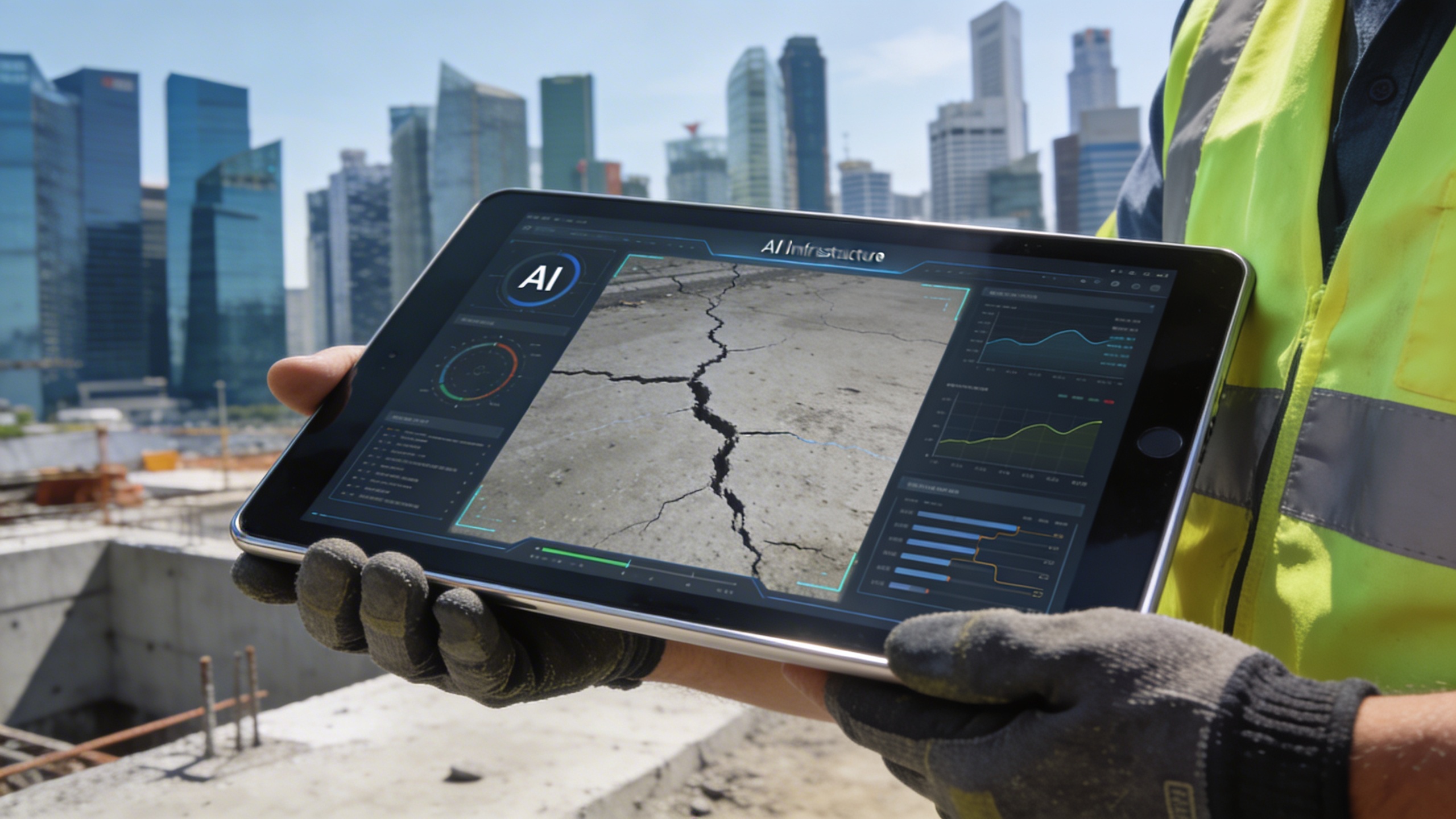
The maintenance and management of aging social infrastructure is a pressing issue facing Japan. In response to this challenge, the AI-powered inspection SaaS “TRASS” has officially launched. Cumulative proof-of-concept trials at nine sites have demonstrated improvements in operational efficiency and inspection quality.
At first glance, this appears to be merely the emergence of a new technical tool. However, delving deeper from a management perspective, this news raises a more fundamental question: “Why is AI being introduced into this domain now?” and “What are the conditions for its success?”
Traditionally, the inspection of bridges and tunnels has been a “person-dependent task” heavily reliant on the experience and intuition of skilled technicians—a classic example of an area difficult to digitalize. The fact that AI, provided as a SaaS, has entered this domain can be seen as evidence that management is beginning to proactively define IT for “solving field-level problems.”
From “Delegating Means” to “Defining Purpose”: The Lesson from Mizuho Trust & Banking
Here, let’s reference another piece of news. Mr. Yamamoto, CIO of Mizuho Trust & Banking, discussed the company’s digital transformation “MINORI,” touching on the essence of IT strategy. In transforming a century-old trust business, what was crucial was not the technology itself, but clarifying the purpose: “Why are we transforming?”
This way of thinking is something small and medium-sized enterprise (SME) managers, in particular, should take to heart. Cloud services and AI tools, led by platforms like Azure, now offer a wealth of accessible options for SMEs as well. The background of ITmedia articles introducing Azure usage scenarios for SMEs also reflects this proliferation of tools.
However, the very accessibility of tools creates a potential trap: “means-first” thinking. Approaches like “We’ll introduce it because AI is trending” or “We must migrate to the cloud” make return on investment unclear. The Mizuho Trust case shows that a key success factor was management itself defining the purpose: “What new value will we provide to customers through digitalization?”
The “Undefined Problem” That TRASS Solved
Let’s analyze the case of the infrastructure inspection AI “TRASS” from this perspective. This tool solved two fundamental problems.
The first is the “standardization of inspection quality.” It supplements or replaces judgments previously swayed by individual differences among skilled technicians with the objective benchmark of AI. This can be seen as using IT to numerically and visually define and make manageable the management objective of “quality” for the first time.
The second is the “assetization of data.” The images obtained from inspections and the AI’s judgment results become valuable data assets for predicting facility deterioration over time, not just operational records. It redefines inspection work from a “cost center” to a “data generation hub supporting future investment decisions.”
Thus, successful field digitalization is not merely about “replacing paper-based work with tablets.” It is the result of management defining: “What is the purpose of that task? How can digitalization elevate that purpose?”
The Role Information Systems Should Play: “Translator of Purpose”
So, after management defines the purpose, who should handle the concrete technology selection and implementation push? This is where the Information Systems department (Info-Sys) plays a critical role. The significance of ITmedia providing Azure utilization articles labeled “A Must-Read for Info-Sys Staff” also lies here.
What is required of modern Info-Sys is not merely being guardians of infrastructure, but acting as bridges that translate “the purpose defined by management” into “technical solutions usable on the front lines.” For example, if management defines “We want to double customer response speed,” Info-Sys must be able to present concrete options to achieve that—such as introducing a CRM, utilizing chatbots, or automating workflows (with RPA, Power Automate, etc.)—while clearly indicating costs and effects.
In SMEs, there is often no dedicated Info-Sys staff. In such cases, the manager themselves or an external IT consultant must take on this role. The crucial point is not to skip this “translation” process. The gap that arises between “management’s abstract purpose” and “the field’s concrete tools” is the primary cause of IT investment failure.
Practical Framework: 5 Questions Managers Should Ask
To ensure the success of field digitalization, managers should answer the following five questions before diving into discussions about specific tools.
- What is the essential purpose of the target task? (e.g., The purpose of inspection is not “creating reports” but “ensuring facility safety and predicting lifespan.”)
- To what level can that purpose be elevated through digitalization? (e.g., From human judgment to quantitative analysis + prediction by AI.)
- What is the definition of success? How will it be measured? (e.g., 30% reduction in inspection time, halving judgment variance.)
- What new data will be generated? Which management decisions can it inform? (e.g., Using deterioration data to prioritize the next repair plan.)
- After tool introduction, how will human roles change, and how will people be developed? (e.g., From routine tasks to final verification of AI judgments and proposal work based on predictions.)
The TRASS case can be said to have proven its effectiveness in trials precisely because it had clear answers to these questions.
A New Criterion for SaaS Selection: Foreseeing the Data Exit
The criteria for tool selection must also change. Until now, “features” and “price” have been the primary selection criteria for many companies. However, when selecting based on a defined management purpose, more important criteria are added: “data liberality” and “ease of embedding into business processes“.
Even with specialized SaaS like TRASS, it’s crucial how inspection result data can be output and integrated with existing asset management systems or management dashboards. Data trapped within that SaaS cannot become a true asset.
Similarly, when selecting CRMs like Salesforce or HubSpot, or accounting SaaS like Freee or Money Forward, the focus should not be solely on individual feature merits, but on “how seamlessly they can be integrated into your company’s customer response flow and management decision-making processes.” The value of workflow automation tools like Zapier or Power Automate lies precisely in enabling this “ease of embedding.”
Conclusion: It is Management’s “Purpose Definition” That Fills the Gap
The emergence of infrastructure inspection AI, the digital transformation of a century-old company, and the democratization of the cloud. At the intersection of these three news stories emerges the reality that IT is no longer a “gap” that can be left to the experts.
The more technology becomes advanced and generalized, the greater the importance of the fundamental question: “For what purpose are we using this technology?” The ones who can answer this question are not the technologists, but the managers—the ultimate responsible parties in the organization.
AI and SaaS are powerful tools. However, tools only gain meaning through the intent of their users. The first step to successfully guiding field digitalization is not searching for the latest tools, but beginning by re-examining the purpose of your company’s field operations and redefining it in the manager’s own words.

Comments