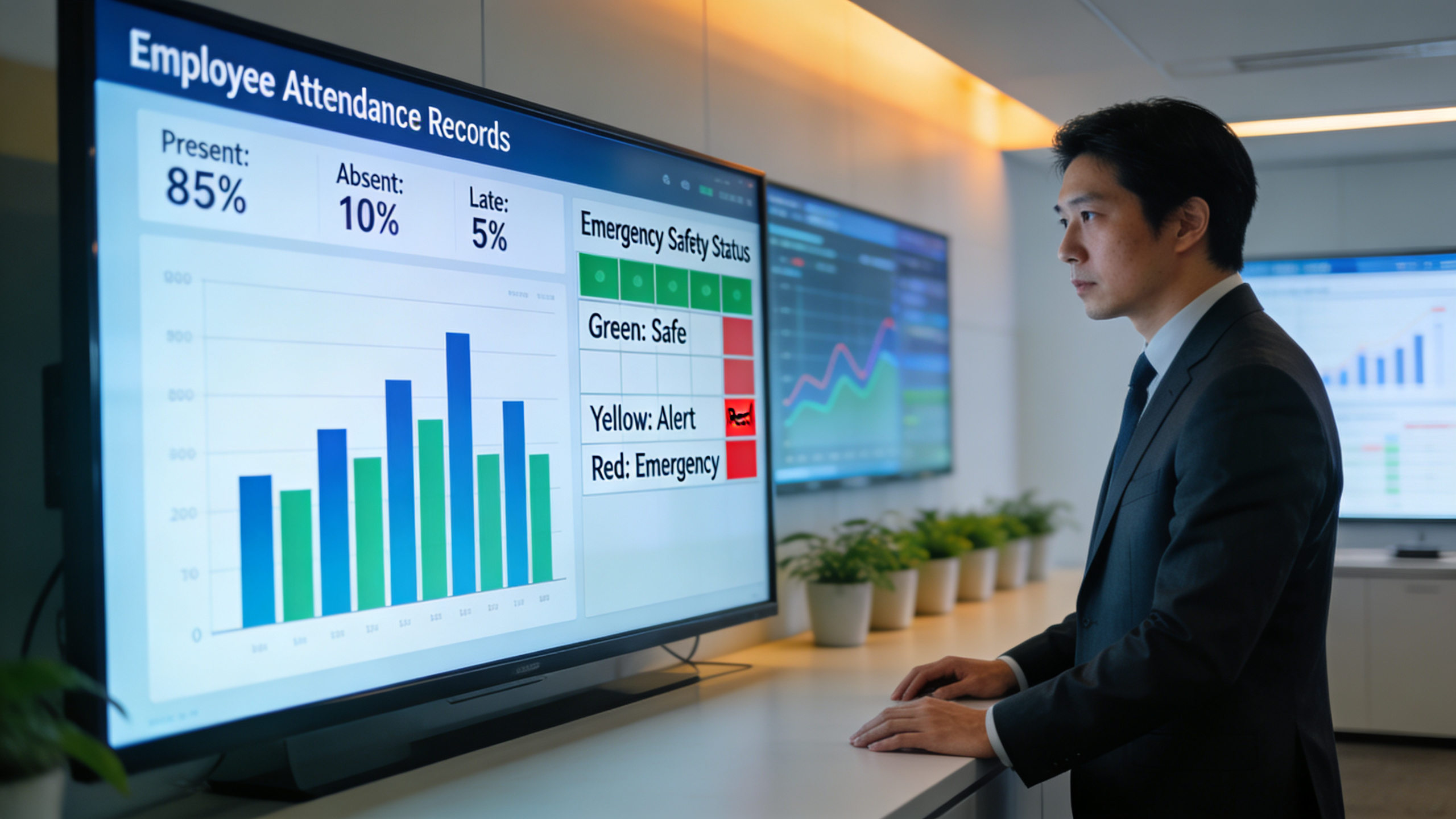
When Attendance Management Becomes Your “What If” Preparedness
A noteworthy system will be showcased at the “6th Digitalization & DX Promotion Exhibition ODEX” held at Tokyo Big Sight from May 13, 2025. The news is that the attendance management system ‘Dr. Office LookJOB2’ will now include a new “safety confirmation” feature.
At first glance, this might seem like just a “convenient feature addition.” However, this move signals that IT is beginning to offer practical solutions to the serious challenge of BCP (Business Continuity Plan) effectiveness that many small and medium-sized enterprises (SMEs) face.
Business owners, is your BCP just gathering dust on paper? When an earthquake or infectious disease outbreak occurs, the first thing you need is information on “who is safe and who can work.” Without real-time access to this information, you can’t even take the first step toward business continuity.
Why Attendance and Safety Confirmation Should Be Integrated
Traditionally, many companies have implemented attendance management systems and safety confirmation systems separately. Attendance management is handled by general affairs or HR, while safety confirmation falls under general affairs or crisis management. This “siloed” approach hinders the integration of information during emergencies.
For example, imagine the morning of a major earthquake. You want to check on your employees’ safety. But a flood of employees have forgotten their login credentials for the safety confirmation system. Meanwhile, attendance is being clocked via smartphones. The information that “the person who clocked in is alive” is stored in a separate system.
The approach of ‘Dr. Office LookJOB2’ fundamentally eliminates this inefficiency. By placing safety confirmation as an extension of the daily attendance clock-in process, it removes the cognitive barrier of a “system only used in emergencies.”
This is an extremely practical design philosophy that lowers the “hurdle of habit formation” in IT adoption.
Solving BCP “Formalization” with IT
Many SMEs’ BCP plans become mere formalities because they are “not practiced” or “the system is too complex to use.” Safety confirmation systems, in particular, are often only used during annual drills, leading to many cases where employees forget how to operate them when a real crisis hits.
By integrating with attendance management, the daily act of clocking in becomes an update of the “alive and well” status. This means you can always maintain the latest safety information without placing any special burden on employees.
What business owners should consider is, “Is this a system that will truly work in an emergency?” Being an extension of a system used daily is far more important than having perfect features.
Base Your IT Investment Criteria on “Daily Use”
The key management x IT lesson from this news is: “IT investment should be based on daily operations, not just emergencies.”
Countless examples exist of companies introducing high-functioning systems for BCP measures, only to find them unusable during actual disasters. The cause lies in system usability and employee proficiency.
In contrast, attendance management systems are used by nearly all employees every day. Placing safety confirmation as an extension of this brings the learning cost as close to zero as possible.
This way of thinking can be applied to other IT investments as well.
- When introducing a new business system, can it integrate with existing tools (Google Workspace or Microsoft 365)?
- Can operations be completed within chat tools employees already use (Slack or Teams)?
- Is it intuitive enough to use without special training?
By adding this “daily use” criterion to your evaluation, the post-implementation adoption rate will dramatically improve.
3 Key Points for Management to Verify
When evaluating products like ‘Dr. Office LookJOB2’, business owners should focus on the following three points.
First, is data integration between systems real-time? It’s meaningless unless attendance clock-in data is instantly reflected as safety status information.
Second, is the system designed with employee privacy in mind? Linking attendance data with safety information carries the risk of excessive monitoring of location data and activity history. Establishing clear employment rules and privacy policies is a prerequisite.
Third, is there a balance between implementation and operational costs? For SMEs that can’t afford massive investments in BCP measures, the approach of adding functions to tools used in daily operations is the most realistic.
What to Look For at the DX Promotion Exhibition: “The Next Step”
At this year’s ODEX, various other digitalization solutions will also be exhibited. Business owners and IT department personnel should view the exhibits not just for product comparison, but from the perspective of “how to integrate this into our own business processes.”
I particularly recommend visiting each booth with the following viewpoints in mind.
- Can this tool be introduced without changing employees’ “existing behaviors”?
- Is it clear who will be responsible for maintenance after introduction?
- Can it integrate data with other systems (availability of API)?
IT is a means to achieve management strategy. BCP measures are not just “preparedness,” but an investment at the core of management: “continuing operations to deliver value to customers.”
Attendance tracking becoming safety confirmation. This simple shift in thinking holds the potential to transform many SMEs’ BCPs from “plans on paper” into “actionable systems.”
Summary: The Strongest IT is the One That Blends into Daily Life
The essence of this news is that IT tools should not be “things used on special occasions,” but rather “an extension of daily life.”
I recommend that business owners shift their mindset from treating BCP as an “annual drill” to embedding it into daily workflows. This very decision is what truly constitutes DX promotion and an investment that enhances business sustainability.
If you get a chance to see a live demo at ODEX, please evaluate it from the perspective of “Can our employees use it without resistance?” The success of IT implementation depends less on technical excellence and more on whether it is accepted on the front lines.
Comments