- The Misconception Behind AI Adoption and Staff Reduction
- The Limits of IT Investment Focused Solely on Cost Cutting
- The Structural Problem of SMEs Without Dedicated IT Departments
- The Miscalculation from Confusing “Business IT” with “Administrative IT”
- The True Purpose of AI Adoption Lies in “Designing Reproducibility”
- Three Actions Business Owners Should Take Now
- Conclusion: AI Adoption Is a “Means,” Not an “End”
The Misconception Behind AI Adoption and Staff Reduction
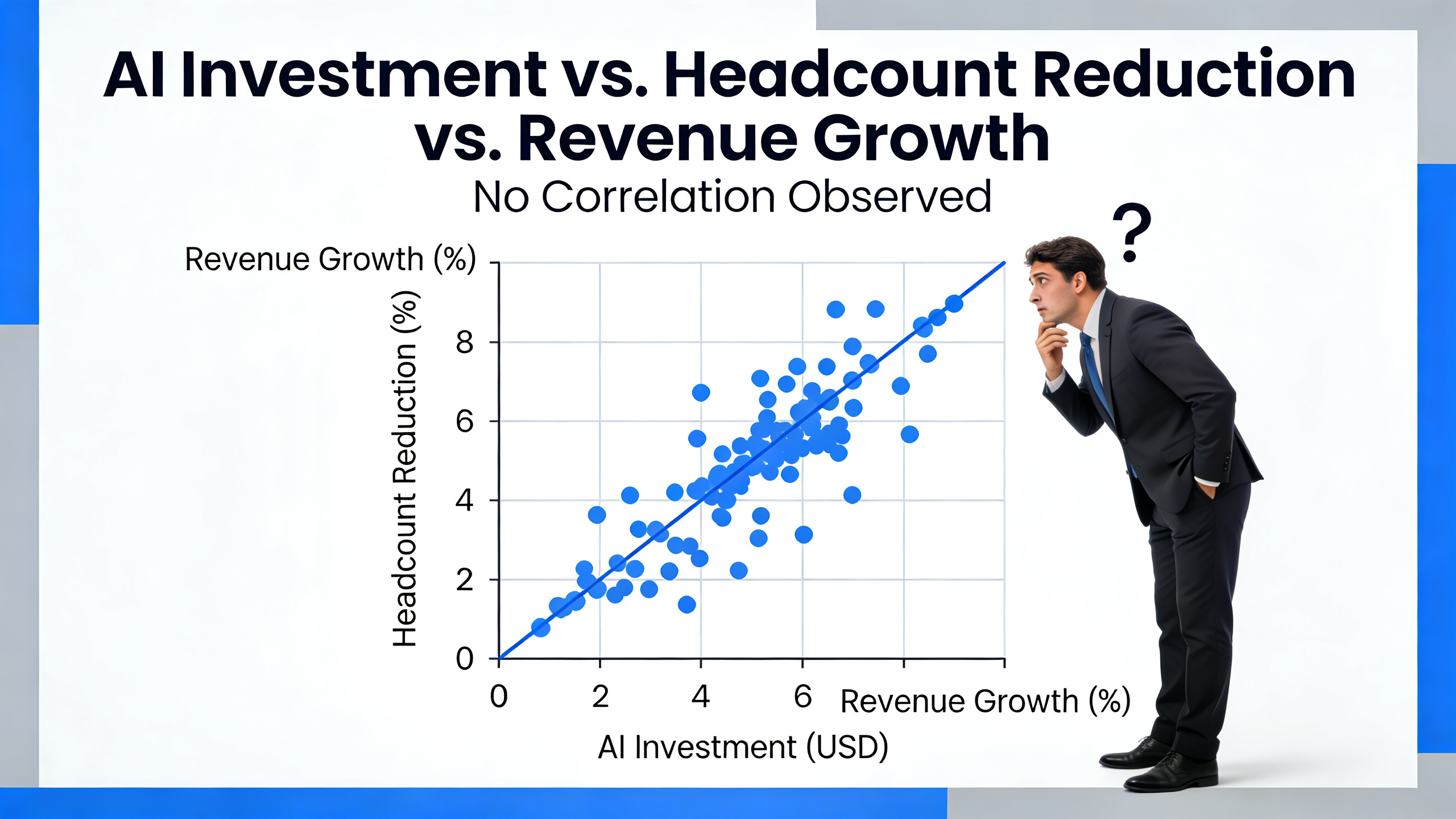
“If we introduce AI, we can cut staff. Reducing staff lowers costs and boosts profits.” Many business owners believe in this simple equation. However, the latest research flatly denies this assumption.
According to a report by ASCII.jp, data shows that reducing staff through AI adoption does not necessarily lead to increased revenue. This is a harsh reality for many SME owners.
Why doesn’t staff reduction directly translate to profit growth? The reason lies in a fundamental flaw in how IT investment goals are designed. This article uses this news as a starting point to explain common misconceptions about IT investment among business owners and the mindset needed to achieve real results.
The Limits of IT Investment Focused Solely on Cost Cutting
Many SMEs set “cost reduction through staff cuts” as the goal for AI adoption. However, this approach has a major pitfall.
IT investment aimed solely at cost cutting may contribute to short-term numerical improvements, but it rarely leads to long-term competitive strength. Why? Because cost cutting is a one-time achievement and doesn’t serve as a sustainable growth engine.
For example, imagine introducing an AI chatbot for customer support and halving the staff handling inquiries. Labor costs certainly decrease. But the AI merely streamlines existing tasks—it doesn’t create new value.
What’s truly needed is for management to define the purpose of AI adoption: “What do we want to achieve with AI?” Cost reduction should be a secondary effect, while the primary goal should be directly tied to business growth, such as “improving customer experience,” “creating new business opportunities,” or “accelerating decision-making.”
The Structural Problem of SMEs Without Dedicated IT Departments
The same news report also highlighted that two out of three SMEs lack a dedicated information systems department. This fact vividly illustrates the structural reason why AI adoption goals tend to skew toward cost cutting.
In companies without a dedicated IT department, decisions about IT adoption are usually made by the business owner or by staff handling multiple roles, such as general affairs or accounting. These individuals have their primary responsibilities and limited IT expertise. As a result, they tend to gravitate toward “cost-cutting tools” that are easy to implement and show visible effects.
However, this very structure is the root cause of IT investment being reduced to a “cost-cutting tool” rather than a “means for business growth.”
What business owners must recognize is that lacking an IT department isn’t a decision “not to invest in IT,” but rather an abandonment of the decision to “define the purpose of IT investment from a management perspective.”
The Miscalculation from Confusing “Business IT” with “Administrative IT”
Our media categorizes IT into three types: “Business IT,” “Management IT,” and “Administrative IT.” The idea of reducing staff through AI adoption falls under the “Administrative IT” mindset.
Administrative IT aims for stable operations and cost control, and it does have some effect. However, what drives a company’s growth is “Business IT.” Business IT directly contributes to revenue expansion and new business creation, and it’s when AI is applied here that it leads to profit growth.
Consider the case of introducing AI into sales activities. Simply automating sales representatives’ visit reports remains within the realm of Administrative IT. But if AI analyzes past order data to predict customers with high closing probabilities and presents them to sales reps, that becomes Business IT. This improves sales efficiency and directly boosts revenue.
The problem is that many SMEs jump at quick cost-cutting effects without distinguishing between “Administrative IT” and “Business IT.” Business owners need to clearly recognize which category their IT investment falls into.
The True Purpose of AI Adoption Lies in “Designing Reproducibility”
Here’s the key point: the essence of AI adoption isn’t “reducing human work” but “making excellent results reproducible.”
The expertise of top salespeople or skilled field workers is often personal—if they leave, that knowledge disappears from the company. AI is a powerful tool for converting such tacit knowledge into explicit knowledge, creating a system that can be shared and utilized across the organization.
If the goal is designing reproducibility rather than staff reduction, the evaluation criteria for AI adoption change. The KPI becomes not “how many people were cut,” but “how well can the organization reproduce superior decisions across the board?”
For example, consider introducing AI into quality control in manufacturing. Replacing visual inspections by skilled inspectors with AI can reduce staff. But more importantly, AI ensures reproducibility by “not missing defective products.” This leads to effects directly tied to revenue, such as stable product quality and enhanced brand value.
Three Actions Business Owners Should Take Now
Instead of aiming for staff reduction through AI adoption, business owners should take the following three actions to generate real results.
1. Redefine the Purpose of IT Investment as “Business Growth”
Set KPIs directly linked to business growth, such as revenue expansion or improved customer experience, rather than cost cutting. For example, a specific goal like “increase new customer acquisition by 20% through AI adoption.”
2. Recognize the Risk of Lacking an IT Department and Leverage External Resources
If you can’t have a dedicated IT department, utilize external IT consultants or SaaS implementation support services. What matters is not “who to delegate to,” but for management to define “what we want to achieve.”
3. Think About “Designing Reproducibility” Before Implementation
When considering AI adoption, always ask: “Whose excellent judgment will this AI make reproducible across the organization?” The presence or absence of this perspective greatly affects the investment’s effectiveness.
Conclusion: AI Adoption Is a “Means,” Not an “End”
The fact that reducing staff through AI doesn’t increase revenue provides an opportunity for business owners to rethink the essence of IT investment. AI is merely a means; the goal is business growth. Instead of a short-term focus on cost cutting, rethinking IT investment from a long-term perspective of designing reproducibility is essential for future management.
If management doesn’t define the purpose of IT, AI will end up as just a cost-cutting tool. Conversely, if management introduces AI with a clear purpose, it can become a source of competitive advantage. Which path is your company’s AI adoption taking?


Comments