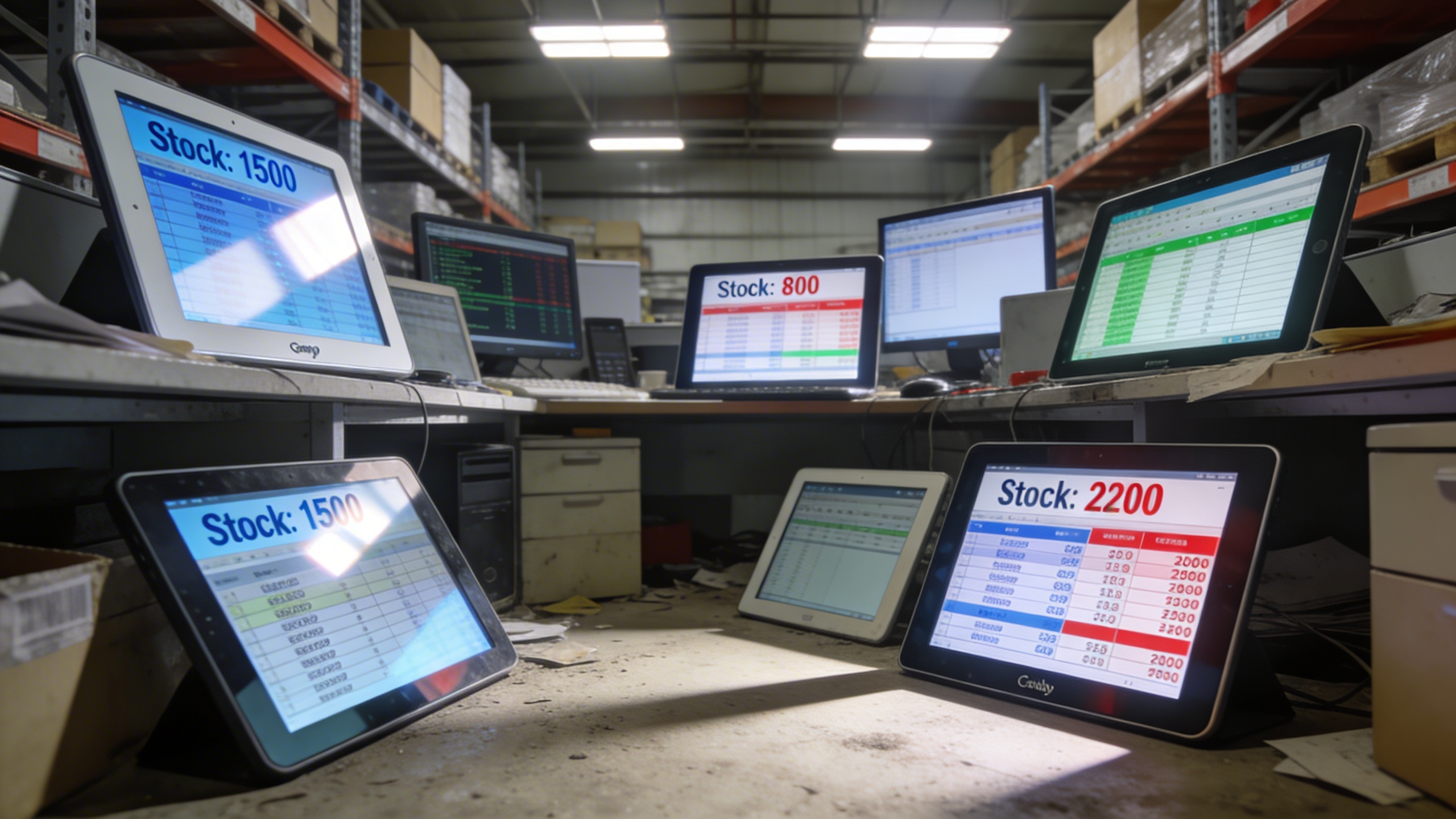
The introduction of an inventory management system leads to disparate operations at each front line. Is this common tale simply a matter of field stubbornness or low IT literacy? The five cases reported by Nikkei CrossTech, “Overcoming the Hurdles of Inventory Management Digitalization: 5 Cases Where Operations Varied by Site,” reveal a more fundamental management issue beneath the surface. It is the result of management failing to define “what they want IT to achieve,” instead throwing the means—”digitalization” itself—as the goal to the front lines.
Before Demanding “Integration”: The “Design” Responsibility Management Abandoned
The five reported cases are all success stories that somehow resolved the symptom of “disparity.” However, what executives and CTOs should learn from this is not the “HOW” of the solution, but the structural “WHY” of how such a state arose in the first place.
Inventory management is not merely the task of “managing the quantity of items.” It is a central operation managing the “flow of information,” akin to a company’s circulatory system, which runs through sales planning, production planning, procurement planning, and even cash flow planning. How this information flow is designed is a pure management decision directly linked to business strategy itself.
Yet, in many companies, only a vague request like “we want to manage inventory digitally” comes down from above, while the means of realization (which tool to choose, how to implement it) are left to individual departments on the front lines, or sometimes to the IT department. This creates a fatal “split in the objective function.” The factory floor prioritizes “minimizing production stoppages,” the warehouse prioritizes “speed and accuracy of picking,” sales prioritizes “immediate inventory confirmation,” and accounting prioritizes “accuracy of valuation.” When each site optimizes without a common purpose, disparate systems and operations are an inevitable outcome.
The split was designed the moment management ordered “digitalize” without defining a purpose such as “improve company-wide decision-making speed by 30% through inventory information.”
“AI365” and “IT Outsourcing Guides”: The Marketization of Solutions and Its Perils
Services to solve such field confusion are rapidly appearing on the market, as if in response. Services like “AI365,” which supports AI utilization starting from approximately $945 per month (approx. 150,000 JPY), and those providing guides for selecting IT outsourcing partners, both sell the idea of having external experts design and implement “the IT purpose that management couldn’t define.”
This certainly seems like a practical solution. However, there is a major pitfall here: the outsourcing of management judgment. Is the “optimal inventory management purpose” defined by an external consultant one that reflects our company’s unique business strategy and competitive advantage? Or is it an average, one-size-fits-all solution under the name of industry best practices?
The background of IT outsourcing services (starting from approx. $1,134 per month / 180,000 JPY) offering “failure-proof selection guides” is a demand stemming from management’s lack of “selection criteria” itself. The guide provides judgment criteria like “budget,” “track record,” and “scope of support.” However, the most important criterion—the management vision of “what our company demands from IT”—is not written in the guide. If management selects an external service without this vision, it is nothing less than the “outsourcing of IT’s purpose.”
Fujifilm Business Innovation’s approach to DX suggests a different path. The company is productizing the “know-how of digitalization” accumulated during its own business transformation process. This represents a higher-order stage: defining and practicing IT based on one’s own strategy, and offering the “blueprint for reproducibility” itself as value to the external market.
M&A “IT PMI” Exposes the Negative Legacy of Integration Impossibility
The moment when the cost of management not defining IT’s purpose appears most dramatically is during M&A. The reported “IT PMI (Post Merger Integration) Package” supports the challenge of how to quickly integrate different IT systems and security policies after a merger.
But consider this: If each company had defined a consistent IT objective function based on its management strategy and built systems accordingly, how much would the difficulty of integration decrease? Integration is not merely a technical connectivity issue. It is a clash of management philosophies—where Company A’s design philosophy of “inventory information prioritizes production efficiency” collides with Company B’s philosophy of “inventory information prioritizes minimizing lost sales opportunities.”
The reason PMI services require one-stop support from Day 1 is the absence of a management philosophy that should be agreed upon. The integration work is, more than a technical difficulty, the very process of forming management consensus on “what will we prioritize as a company going forward?” Without this agreement, tenant integration and security unification risk ending as mere temporary “hodgepodges.”
Three Questions for Management to End “Disparate Operations on the Front Lines”
So, where should executives start? First, they should begin by asking the following three questions regarding any IT system to be introduced or renewed (not limited to inventory management).
First Question: What specific management KPI is this IT intended to contribute to, and how?
“Operational efficiency” is a means, not an end. It must be linked to quantifiable management outcomes, such as “reducing lost sales opportunities by X% annually by shortening the lead time from order to shipment.” This purpose becomes the common language across departments.
Second Question: How should information flow to achieve that purpose?
Once inventory data is updated in the warehouse, who needs to know that information within how many seconds? Based on that information, what decision-making authority does sales have? This is not about digitizing workflow, but designing the decision-making process itself.
Third Question: Does that purpose and design have “reproducibility” with an eye on future M&A or business expansion?
Is it a design that concludes with one current factory, or a design applicable even when the supply chain expands domestically and internationally in the future? This question determines whether IT investment is a stopgap measure or becomes a foundation for corporate growth.
“Defining IT” is Management’s Highest Responsibility
Disparate field operations are not the responsibility of the front lines. It is the responsibility of management, which, before ordering “integrate” from above, abandoned drawing the “blueprint” for integration—namely, the purpose of IT—with its own hands.
AI, external services, and M&A support packages are all powerful tools. However, tools merely amplify the user’s intent. If management lacks clear intent, AI will more efficiently realize each department’s convenience, external services will provide mediocre, industry-average solutions, and M&A support will bring about empty integration focused only on technical connectivity.
The single challenge of inventory management digitalization is a mirror reflecting the state of management. Rather than lamenting disparate operations, acknowledge that the cause lies in a void of management decision-making. From there begins the long, arduous, yet unavoidable path of redefining IT from “a technology left to specialists” to “a decision-making apparatus designed by management.”


Comments