- The Reality of Logistics DX: A Shocking Figure Below 30%
- The “Negative Chain” Created by Partial Optimization
- The Importance of “Integration” as Shown by the Shoko Chukin Bank Case
- Management Defines IT: Thinking in Three Categories
- Three Steps to Successful Logistics DX
- Conclusion: From Partial Optimization to Holistic Optimization
The Reality of Logistics DX: A Shocking Figure Below 30%
A maturity survey on logistics DX released by Deep Current has sent shockwaves through the industry. The finding that less than 30% of core business operations are digitized is likely far lower than many executives anticipated.
This result doesn’t just indicate a “delay in digitalization.” It highlights a deeper structural issue: how management has positioned IT within the organization.
Why Isn’t Logistics DX Progressing?
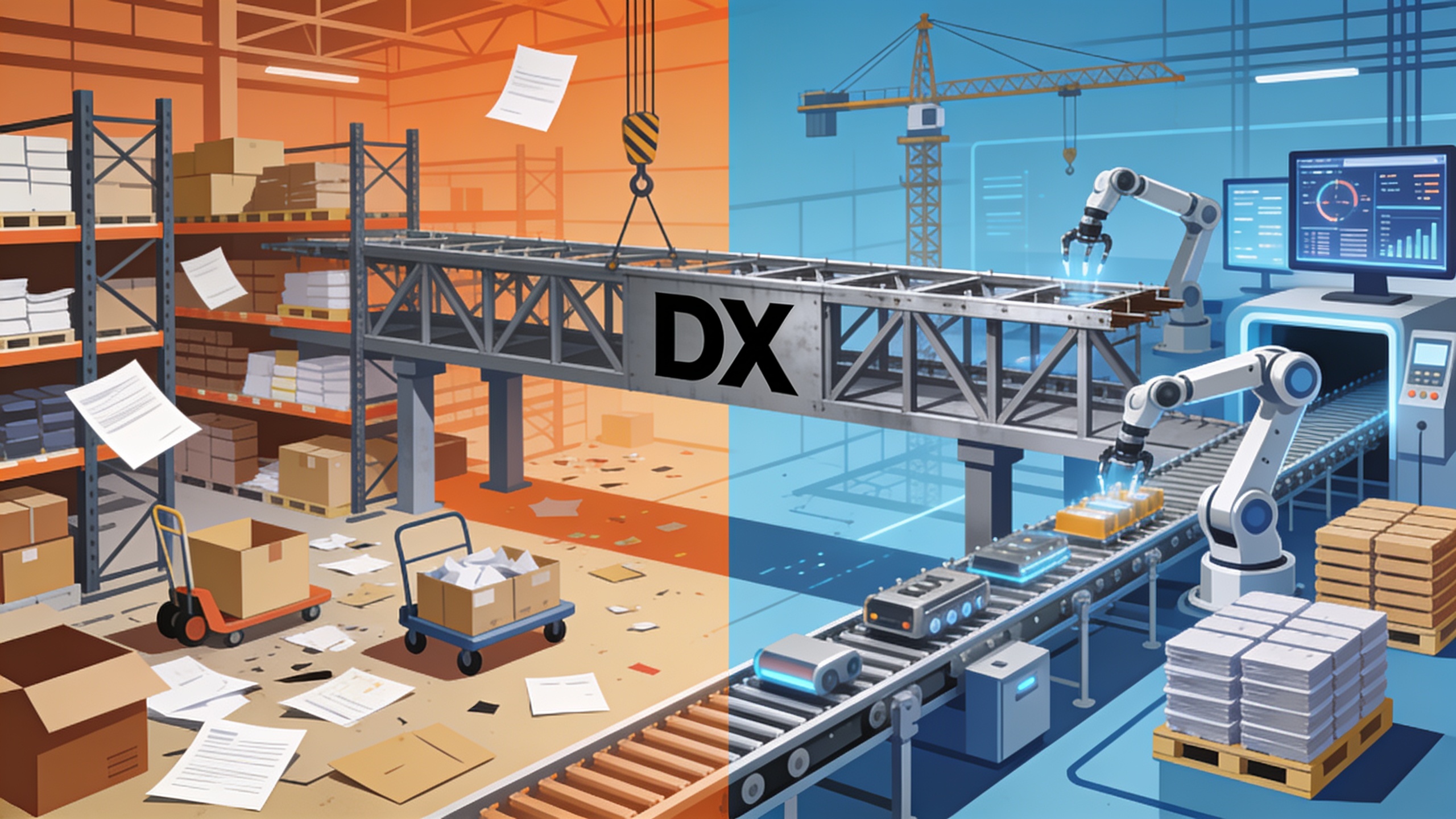
In the logistics industry, individual operational areas like delivery management and inventory management are often relatively digitized. However, the current reality is that these systems are not integrated as a “core business whole.”
This is a classic example of what we have repeatedly pointed out as “fragmentation of objective functions.” Each department pursues efficiency for its own unit, resulting in a structure where overall optimization cannot be achieved.
For instance, the system introduced by the delivery department doesn’t integrate with the one from the warehouse management department, leading to duplicate data entry. Isn’t this a common sight in many workplaces?
The “Negative Chain” Created by Partial Optimization
When logistics DX remains at the level of partial optimization, it creates the following negative chain.
Data Disconnection Delays Decision-Making
When systems are fragmented, it’s impossible to grasp the overall situation in real-time. Without integrated data on inventory status and delivery status, creating an optimal delivery plan is impossible.
The “holistic decision-making” that management requires is only possible with integrated data. Stuck in partial optimization, management is forced to rely on “intuition and experience,” failing to maximize the return on IT investment.
Increased Reliance on Specific Individuals, Loss of Reproducibility
Fragmented systems inevitably lead to a reliance on specific individuals—”Ask that person, they’ll know.” Only certain employees master the systems, and operations halt when they are absent. This makes business reproducibility impossible to guarantee.
The essence of management IT lies in “designing for reproducibility.” In a state of reliance on specific individuals, scaling the business is difficult, and it poses a significant risk during M&A or business succession.
The Importance of “Integration” as Shown by the Shoko Chukin Bank Case
Conversely, even within the same financial industry, the case of Shoko Chukin Bank introducing Salesforce to evolve its team-based sales approach demonstrates the importance of integration.
Shoko Chukin Bank centralized customer information and shared it among sales representatives, boosting the entire team’s sales capabilities. This is a prime example of aiming for overall optimization, not partial optimization.
This perspective of “integration” is also essential for the logistics industry. Integrating data from delivery, warehousing, and inventory to achieve optimal operations as a whole—that is what true logistics DX should be.
Management Defines IT: Thinking in Three Categories
To advance logistics DX, management needs to classify IT into three categories: “Business IT,” “Management IT,” and “Administrative IT.”
Business IT: Prioritizing On-Site Speed
This area focuses on pursuing on-site speed, such as optimizing delivery routes or improving warehouse picking efficiency. Here, it’s important to introduce tools quickly and run PDCA cycles. However, you must not let this area operate in isolation.
Management IT: Enhancing Decision-Making Quality
Management IT is the foundation that integrates data obtained from Business IT, enabling management to make quick and accurate decisions. It requires using dashboards and BI tools to visualize data from a holistic optimization perspective.
Administrative IT: Stable Operations and Cost Management
This area requires stable operations, such as core systems and networks. Here, cost management and security measures are critical.
The key point is that these three types of IT must be designed under a “common objective function.” If their purposes are fragmented, they will develop independently and become impossible to integrate. The current state of logistics DX vividly illustrates this problem.
Three Steps to Successful Logistics DX
So, how can you specifically lead logistics DX to success? We propose the following three steps.
Step 1: Management Defines the “Purpose of IT”
First, start by having management clearly define “why IT is necessary.” Is it to increase sales, reduce costs, or improve customer satisfaction? Once the purpose is clear, the direction for the tools and systems to introduce will naturally become apparent.
Step 2: Build a Foundation for Data Integration
Next, build a foundation to integrate data from various systems. Consider API integration or introducing a data warehouse to eliminate data silos between departments. At this stage, rather than suddenly implementing a large-scale system, it’s more realistic to start small using cloud services.
Step 3: Strengthen Communication Between the Front Line and Management
Finally, establish regular communication about IT between the front line and management. Management must understand the challenges on the ground, and the front line must understand management’s strategy. This two-way communication is the key to DX success.
Conclusion: From Partial Optimization to Holistic Optimization
The “less than 30%” figure from the logistics DX maturity survey is not a cause for pessimism. Rather, it should be seen as a positive message that there is still significant room for improvement.
The crucial point is to avoid the trap of partial optimization and redesign IT from a holistic optimization perspective. Management must define IT and unify the objective function. That is the only true path to successful logistics DX.
Where should your company’s logistics DX begin? Why not start by taking stock of whether your company’s IT is skewed towards “Business IT,” “Management IT,” or “Administrative IT”?


Comments