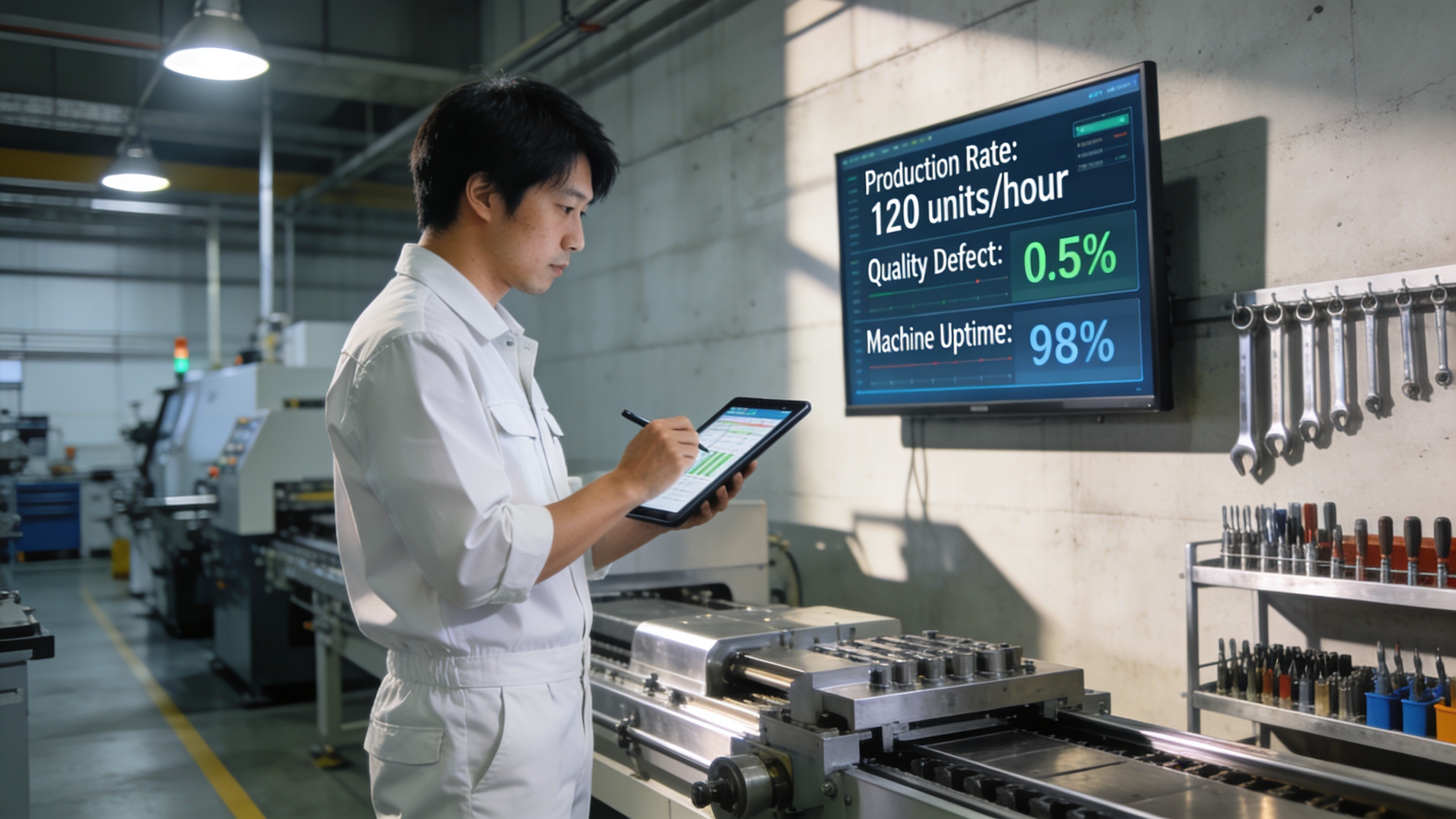
The Hidden Challenge of “Record-Keeping” on the Factory Floor
In manufacturing, paper-based record-keeping is still the norm. Daily reports, inspection logs, inventory management, equipment checks—these tasks are often handwritten and later entered into Excel. This double workload has become routine for many small and medium-sized manufacturers.
This “record-keeping” is the first step in manufacturing DX, yet it’s the most overlooked area. Why? Because recording itself is a “must-do” task, not a “profit-driving” one.
However, without digitizing record-keeping, on-site data can never be used for management decisions. Visualizing productivity, ensuring quality traceability, and analyzing equipment uptime all rely on accurate records.
The Shocking Price Point: ¥5,000 a Month (~)
The newly launched “Kakanai LITE” is a service specifically designed to digitize record-keeping. What stands out is its price. Starting at ¥5,000 per month (~$35), it’s an extremely realistic option for small manufacturers.
Typical production management systems or ERPs for manufacturing cost millions of yen to implement, with monthly fees ranging from tens of thousands to hundreds of thousands of yen. That’s out of reach for small businesses with a few dozen employees.
Kakanai LITE achieves this price by focusing solely on “record-keeping.” Specifically, it includes features like:
- Digital input for daily and work reports
- Electronic inspection records
- Simplified inventory management
- Real-time data sharing
All of these digitize the on-site tasks of “writing,” “collecting,” and “transcribing.” It doesn’t include advanced production planning or demand forecasting. But that’s exactly what makes it “just-right DX” for small businesses.
The Hidden Cost of Paper Records That Managers Often Miss
Here, I want managers to consider how much “paper records” actually cost.
For example, in a factory with 20 employees, if each spends 30 minutes a day on record-keeping, that’s 10 hours a day, or 200 hours a month, lost to recording. At an hourly wage of ¥1,500 (~$10), that’s ¥300,000 (~$2,100) in labor costs spent on record-keeping each month.
Add in the cost of paper, printing, storage space, and the time spent on later data entry and aggregation, and it’s clear how much a ¥5,000/month (~$35) tool can save.
More importantly, there’s the “value of data” gained through digitization. Paper records become “past information” the moment they’re written. But digital data can be shared in real-time and analyzed when accumulated.
You can instantly answer questions like, “Why did this defect occur in this process?” or “Which equipment’s uptime is dropping?”
PFU’s New Service Points to “Outsourcing IT Departments”
Meanwhile, PFU’s “Jōshisysu no OTOMO” should be viewed in the same context. This service supports small businesses’ IT department tasks externally, offering IT asset management, security measures, and help desk support at a fixed monthly fee.
These two news items reveal a reality: “Small businesses’ IT challenges can be adequately addressed with low-cost, focused services.”
When people talk about manufacturing DX, large-scale system implementations and AI use often steal the spotlight. But the on-site reality is much more basic. The first step should be humble and steady: “digitize records” and “outsource IT tasks.”
DX Failures Come from “Overdoing It”
The reason many small businesses fail at DX is that their goals are too big. “Company-wide business reform,” “AI-driven demand forecasting,” “IoT-powered smart factories”—these are ideals, but they can’t be achieved overnight.
The key is to start small, feel the impact, and then expand. Services like Kakanai LITE are perfect for that first step.
Start by digitizing on-site record-keeping. That alone gives you data for management decisions and makes waste visible. Then, based on that data, you can think about the next step.
What Managers Should Do Right Now
Finally, I’d like to suggest concrete actions for managers.
First, visualize how much time your on-site “record-keeping” takes. Calculate the time per person, number of employees, and labor costs—then you can quickly see the ROI of digitization.
Next, try a low-cost tool like Kakanai LITE on a trial basis for one process or department. The risk of failure is just ¥5,000/month (~$35). If you can’t take that risk, DX will never begin.
After implementation, think about “how data can be used for management decisions.” Digitizing records is a means, not an end. The real goal is productivity improvement and quality enhancement.
Manufacturing DX isn’t anything special. It starts with digitizing the on-site tasks of “writing,” “collecting,” and “transcribing.” And that first step is now affordable for everyone.


Comments