- DX Outcomes Cannot Be Measured by “Visible Reform” Alone
- “Split Objective Functions” Lead to Fragmented IT
- The “Management-Led IT Redefinition” Process Demonstrated by Yao City
- Transforming the IT Department’s Role: From Cost Center to Value Creation Engine
- Where Does Your Company’s “Invisible Reform” Begin?
DX Outcomes Cannot Be Measured by “Visible Reform” Alone
The administrative DX initiatives being advanced by Yao City in Osaka Prefecture have been reported. The article explains them by separating “visible reform” and “invisible reform.” Most executives and DX managers likely focus on the “visible reform.” Visible outcomes like streamlining counter services and going paperless are easier to document in reports and directly linked to budget approval.
However, the real hints for transforming a company’s IT strategy actually lie on the side of “invisible reform.” This refers to foundational work like “data standardization” and “process commonalization”—mundane tasks whose results are not immediately apparent. When we interpret Yao City’s case in light of the “management x IT” challenges faced by private companies, a fundamental question emerges.
That question is: Why do executives tend to postpone investment in this “invisible reform”? And what price do they pay as a result? While the scale differs between public administration and business, this structure is strikingly similar.
“Split Objective Functions” Lead to Fragmented IT
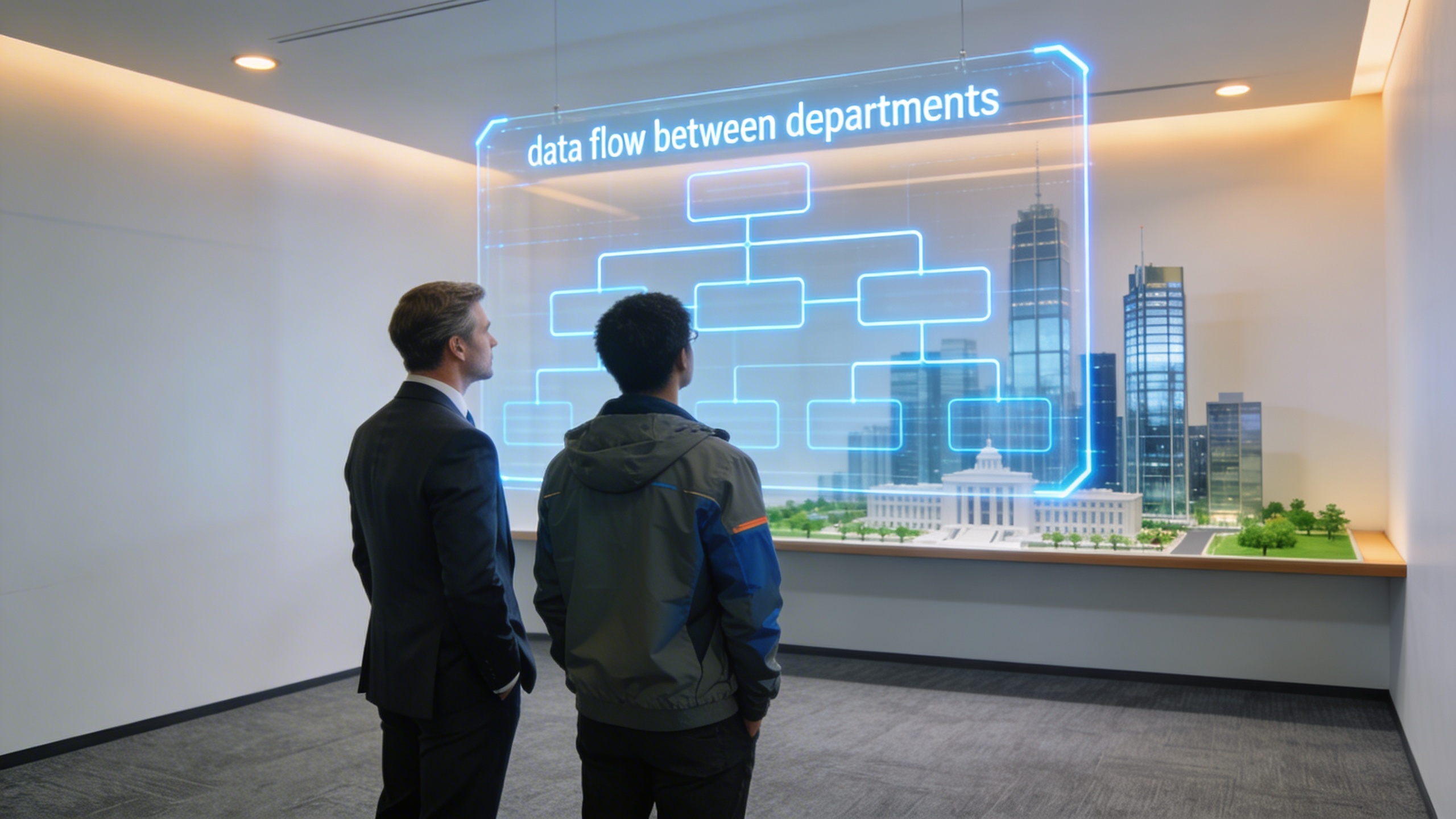
In Yao City’s DX, “invisible reform” is progressing—reviewing data and systems held individually by each department cross-functionally and building common foundations. This is precisely a move to resolve the “split objective functions” this media has repeatedly highlighted.
In many companies, the objectives for IT are fragmented by department. The sales department seeks “IT for fastest revenue growth,” marketing wants “IT for acquiring more leads,” and accounting desires “accurate and stable IT.” Each objective is valid. However, because top management failed to define a “common objective function” that integrates these different goals, each department independently adopts SaaS, data becomes siloed, and company-wide decision-making relies on manual Excel work.
The “separate systems per department” faced by Yao City is exactly the “proliferation of SaaS per department” in private companies. Salesforce, HubSpot, Freee, Asana… Even if each is an optimal solution, if they are not connected and data does not flow, they are merely “invisible IT assets” for management.
The Price Management Has Paid for Avoiding “Invisible Reform”
So, why don’t executives invest in “invisible reform” like data standardization and building common foundations? The psychology is clear: because ROI (Return on Investment) is difficult to calculate.
It’s easy to estimate that “introducing Salesforce will improve sales efficiency by XX%.” However, quantifying the value of “building a company-wide data integration foundation will improve decision-making speed in three years” is extremely difficult. As a result, in management meetings, budgets for “visible reform” get approved, while “invisible reform” is pushed into the IT department’s budget as “technical infrastructure work” and falls prey to cost-cutting pressures.
This is the reality behind the management decision to “leave IT to the experts.” It’s not delegation; management itself has retreated from the difficult-to-judge domain of “invisible reform.” As a price, executives are constantly forced to make decisions based on outdated, fragmented data, and “data-driven management” remains just a slogan.
The “Management-Led IT Redefinition” Process Demonstrated by Yao City
What’s noteworthy in Yao City’s case is that this “invisible reform” is being driven top-down by the city’s leadership. This can be reinterpreted as a model case for “management-led IT redefinition” in companies.
The process can be summarized into the following three steps.
- Define “IT for what purpose?” at the management level: They set a common goal of improving citizen services, moving beyond partial optimization for individual department efficiency.
- Create a “common language” for data and processes: They built the foundation (standardization) for data to flow and have meaning across departments.
- Build the foundation for “visualization” first: Before implementing individual digital service counters (visible reform), they invested in the data integration (invisible reform) that supports them.
Translated for business, this is nothing other than setting a common purpose like “enhancing corporate value” that integrates disparate KPIs such as “revenue growth,” “cost reduction,” and “risk management,” and designing the data flow to achieve it.
Concrete Method: Envisioning a Management IT Platform
So, what should you actually do? Translating Yao City’s “common foundation” for SMEs leads to the concept of a “Management IT Platform.”
This is the idea of establishing a “data hub” that connects all SaaS and operational systems. Rather than a large-scale data lake, a practical first step is an approach combining the following tools.
- Integration Platform (Hub): Zapier / Make (Integromat) / Power Automate. Use these no-code tools to create “data arteries” that automate data flow between SaaS applications.
- Visualization Dashboard: Google Looker Studio / Tableau / Power BI. Establish a “window for decision-making” that visualizes data aggregated in the hub as management indicators (KPIs).
- Defining a Single Source of Truth (SSOT): Clearly define the owner and the trusted single source of data for each domain, e.g., customer master in Salesforce, financial data in Freee.
The crucial point is that management itself must define the “purpose” of building this platform. Link it to the efficiency and qualitative improvement of management activities themselves, such as “connecting all SaaS to halve the man-hours for creating monthly performance review materials and using that time for strategic discussions.”
Transforming the IT Department’s Role: From Cost Center to Value Creation Engine
Yao City’s DX promotion involves a specialized department. This offers a hint for transforming the role of a company’s IT department. Traditionally, IT was seen as the bearer of “management IT,” expected only for “stability and cost reduction.” They were evaluated if the network was stable and costs went down. However, this forever disconnects them from “business IT” (growth) and “management IT” (decision-making).
To promote “invisible reform,” the role of the IT department must be elevated to that of a designer and manager of the Management IT Platform. For this, management must clearly demonstrate the following:
- Changing Evaluation Criteria: In addition to “zero downtime,” add items like “speed of updating management dashboard indicators” and “lead time for company-wide integration of new SaaS” to evaluation metrics.
- Securing Budget: Allocate investment for “invisible reform” infrastructure not as cost-cutting but under a separate line as “management decision-making infrastructure investment.”
- Granting Authority: Give the IT department authority for company-wide rule-setting, such as data standardization and reviewing integration requirements during SaaS adoption.
The IT department begins to function as a “technical architect” for realizing the common purpose defined by management.
Where Does Your Company’s “Invisible Reform” Begin?
Yao City’s administrative DX provides a universal lesson beyond the efforts of a single local government. It shows that the essence of digitalization lies not in individual “visible efficiency gains” but in the “invisible structural reform” that changes the quality and speed of decision-making across the entire organization.
This reform does not start with introducing the latest AI tools. It begins first with executives themselves answering the following questions:
- What is the “common purpose” that integrates your company’s fragmented IT investments (SaaS adoptions)?
- To achieve that purpose, which data should flow, and how?
- As the first step in “invisible reform” infrastructure, what will you invest in this month?
That first step could be listing all major company SaaS and using Zapier to integrate data for even one connection. Or it could be holding a meeting to align the definition of “customer count” that each department holds separately.
The important thing is to have the will to redefine IT not as a “technology to be left to experts” but as a “decision-making apparatus to be designed by management.” Yao City’s “invisible reform” is merely one example of that will taking shape. Your company’s reform begins today with a single question: where do you place that will?


Comments