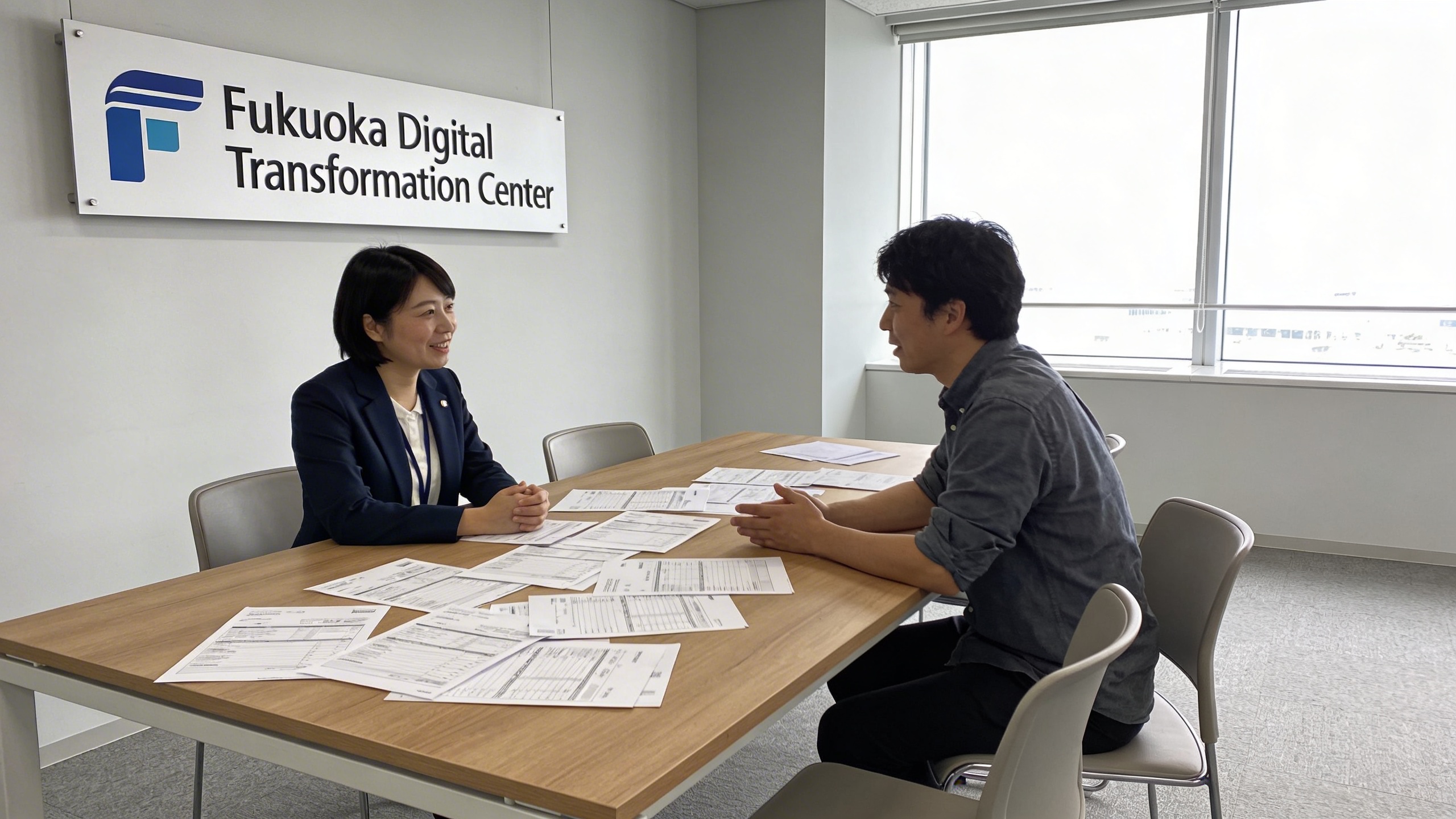
Infomart has opened a “Fukuoka Sales Office & Digitalization Promotion Center” in Fukuoka City. It is a locally-based hub specializing in digitizing invoices. At first glance, this seems like welcome news for regional SMEs, offering substantial support. However, business owners and CTOs need to pause here. The very act of “establishing a local hub” symbolizes a fundamental challenge facing Japan’s IT industry and corporate digitalization.
This is not merely an expansion of sales offices. It highlights the reality that “digitalization”—an issue inherently tied to management decision-making—is being addressed through an extremely analog and person-dependent method: “localized, hands-on support.” From this news, we want to consider the essential questions behind the trend of “localizing IT support” that managers often overlook.
The Real Problem the “Fukuoka Hub” Aims to Solve
Reading Infomart’s press release, the hub’s purpose is clear: to provide face-to-face, thorough support for companies in the Kyushu region, especially SMEs, in digitizing invoice processes (specifically, implementing the cloud invoice service “MakeLeaps”).
What emerges here is the reality of the “digitalization front lines” for Japanese companies, particularly regional ones—a reality that uniform national online support or manuals cannot handle. This includes, for example:
- The Unofficial “Memory of Transactions” Embedded in Paper Invoices: Important information not captured in formal formats, such as stamp placement, handwritten notes, and sticky notes.
- Vague Anxiety Towards Digital Tools and Dependence on “Tangibility”: Especially among accounting staff and older managers, there is a psychological comfort in holding paper and visually confirming the process.
- Regional Business Customs and Language Barriers: Local nuances that standard support cannot fully grasp.
These challenges are rooted less in the technology itself and more deeply in “human psychology and habits.” The fact that Infomart uses the term “Center” and emphasizes face-to-face support is proof that they understand this “non-technical aspect” is the biggest barrier to digitalization.
The Quality of Support and the Risk of Dependence from “Localization”
Certainly, having passionate, excellent consultants stationed locally to provide step-by-step support dramatically lowers the adoption barrier. The successful introduction of the voice AI “iBree” by IA, mentioned earlier, was likely also due to proper initial support. The fact that Parachute’s DX tool for the printing industry became eligible for subsidies also reflects the value placed on industry-specific, detailed support.
However, managers must not stop thinking here. This model of “generous face-to-face support” harbors two significant long-term risks.
The first is the promotion of “Personalization of Support” and “Vendor Dependence.” If there is an excellent Consultant A in the region, a company’s digitalization becomes heavily dependent on A’s skills. The moment A is transferred or leaves, the quality of support can fluctuate greatly. The company builds a dependence not on “Infomart’s service,” but on “Consultant A.” This is an extremely precarious state if we view IT as a means to “design reproducible management,” because the reproducibility depends on an external individual.
The second is the danger of diverting attention from “the essence of digitalization.” Digitizing invoices is not just about scanning paper and uploading it to the cloud. Its essence lies in acquiring a “management decision-making apparatus”—structuring transaction data so it can be immediately utilized for business decisions (cash flow forecasting, supplier analysis, cost management, etc.). However, if generous face-to-face support focuses too much on “how to operate the tool” or “the migration work from paper,” the crucial question for managers themselves—”how to leverage data for management”—tends to be postponed.
Case Study: The Alternative Path Shown by Video Generation AI “NoLang”
In contrast, consider the approach of the video generation AI “NoLang” provided by Mavericks, Inc. The company released samples for SaaS companies that automatically generate videos from slides. The key point here is “the effort to replace human intervention as much as possible with standardized product features.”
Of course, human support is not entirely unnecessary. However, that support is provided in a standardized, productizable form—such as “offering better templates” or “sharing best practices”—rather than “individual hand-holding.” User companies can focus on the tool’s capabilities and how to redesign their own content creation processes. This can be called a model that promotes long-term independence and scalability.
Three Questions Managers Should Ask About “Hub-Based Support”
So, now that local digitalization support hubs are being established, what should managers and CTOs consider? Instead of simply jumping at the “convenience,” they should rigorously ask themselves the following three questions.
1. Is Our “Purpose for Digitalization” Shared with the Support Provider?
“We want to digitize invoices” is a means, not an end. The purpose must be the improvement of specific management metrics, such as “shortening the payment cycle by 3 days to reduce working capital” or “understanding price fluctuations per supplier in real-time to use as negotiation material.” When requesting support, this purpose must be clearly communicated, and you should confirm whether the support will help achieve it. Tools introduced without a purpose quickly become “unused legacy systems.”
2. Is the Path from “Support” to “Independence” Visible?
Generous support during the initial introduction is welcome. However, that support will not last forever. Those receiving support must always be conscious of “when and how to become independent.” Specifically: Is there a plan to develop a key person internally instead of leaving everything to the vendor? Are there opportunities to learn universal workflow and data management principles, not just vendor-specific know-how? Does the support contract deepen dependence, or does it encourage independence?
3. Where Does This Tool/Service Fit in Our Company’s “Overall IT Picture”?
Invoice digitization is both about streamlining accounting tasks (management IT) and building a foundation for business analysis (strategic IT). How will this implementation connect with existing accounting software (e.g., freee or Money Forward) or future BI tools? To avoid ending up with a partially optimized tool without considering the full data journey, design of the “overall IT picture” by management or the CTO is essential. A hub consultant may be an expert in their own product’s implementation but cannot provide advice considering your entire company’s IT architecture.
Leveraging the “Hub” and Making Management Decisions That Transcend Dependence
Infomart’s opening of the Fukuoka hub is indeed a meaningful step to promote digitalization for regional companies. However, the true challenge for managers lies in how to strategically utilize this “convenient hub” and how quickly to achieve “autonomy” from its support.
The ideal relationship is a hybrid model: “Outsource initial hands-on support to the hub, but lead the mid-to-long-term design and independence internally.” Position the hub’s experts not as “subcontractors for tasks,” but as “temporary specialist partners for achieving the goals defined by your own company.”
To do this, the fundamental stance mentioned at the outset—“management defining IT”—is more important than anything. You must first define the business goals that lie “beyond” digitizing invoices, clarify the necessary scope and duration of support to achieve them, and only then can you effectively utilize the resource that is the “hub.”
We are in an era where digitalization support is becoming “localized.” This is proof that technology has become more accessible, but it also marks the beginning of an era where managers’ IT literacy and strategic vision are more critical than ever. Will your company be satisfied just by welcoming a convenient “caretaker,” or will you use that help to design your own “reproducible management”? That judgment will likely determine your competitiveness in the coming years.


Comments