- What Large Enterprise DX Cases Teach Small and Medium Businesses
- The Deeper Meaning of “Digitalizing Project Management”
- The Danger of “Borrowed Management” Driven by Subsidies
- Three Management Benefits Realized by the “Manufacturing DX Platform”
- The First Step in “Management IT” That SMEs Should Take Now
- Why Start with “Digitalizing Project Management”
- Perspectives Executives Must Never Miss in IT Investment
What Large Enterprise DX Cases Teach Small and Medium Businesses
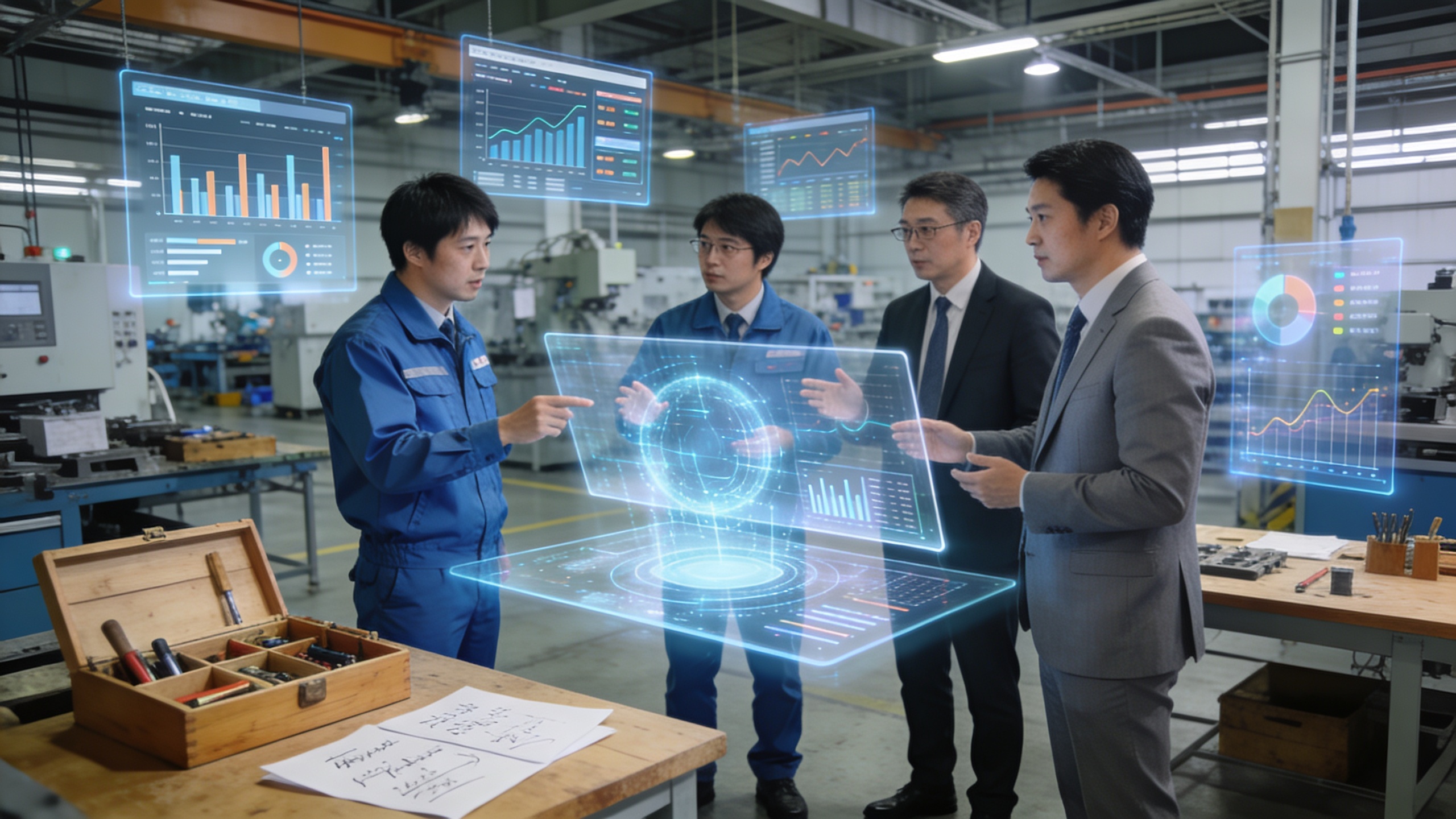
In 2025, Techvify’s manufacturing DX platform for DENSO officially went live. This initiative, which digitalized project management, should not be dismissed as merely a large enterprise case study. Rather, it contains highly insightful lessons for executives considering the essence of IT investment.
Many SME executives may feel that “large enterprise DX is on a completely different scale.” Indeed, global companies like DENSO differ from SMEs in resources and organization. However, the “principles of successful IT investment” that can be extracted from this case are universal and applicable regardless of scale.
The Deeper Meaning of “Digitalizing Project Management”
What deserves attention in this news is the goal of “digitalizing project management.” This is not just about operational efficiency; it’s about building a foundation to visualize project progress in real time and leverage it for management decisions.
The key here is that DENSO clearly defined *what* to digitalize. A common mistake many companies make is the vague goal of “let’s just digitalize.” For example, trying to collect all data from the manufacturing floor, only to end up with a system no one knows how to use. This is a classic case of “IT purpose fragmentation.”
In DENSO’s case, the focus is on project management—an area directly linked to management decisions. This aligns perfectly with the “Management IT” philosophy advocated by this media. Management IT refers to IT investments aimed at improving decision-making and reproducibility. It’s not just about cutting management costs, but about investing to enhance the quality of management.
The Danger of “Borrowed Management” Driven by Subsidies
Around the same time, news also broke that several tools were certified for the “Digitalization/AI Introduction Subsidy 2026.” Inventory management systems, AI communication tools, and more can be introduced at half the cost using subsidies.
Using subsidies is not inherently bad. However, the danger lies in deciding on IT investments *because* of subsidies. “Let’s introduce it because it’s eligible for a subsidy.” This mindset is the biggest cause of divergence between management goals and IT investment.
What DENSO’s case shows is the order: the goal comes first, and IT is the means to achieve it. Subsidies are merely a way to lower the cost of the means; they should not change the goal itself.
Three Management Benefits Realized by the “Manufacturing DX Platform”
What specific management benefits does the manufacturing DX platform built by Techvify bring? They can be organized into three major perspectives.
Real-Time Progress Visualization
When project management is digitalized, the progress of each process can be grasped in real time. The old scenario of learning about delays for the first time at a weekly report meeting disappears. This dramatically improves the speed of decision-making for executives.
Data-Driven Improvement Cycles
By accumulating past project data, you can analyze which processes are bottlenecks and which resource allocations were effective. This enables a shift from subjective “gut feeling and experience” to data-driven management decisions.
Cross-Departmental Information Sharing
The manufacturing floor, administrative departments, and even top management can share project status on the same information platform. Information asymmetry is eliminated, and inter-departmental conflicts are reduced.
The First Step in “Management IT” That SMEs Should Take Now
Even without DENSO’s scale, there are principles that SMEs can apply. That is: “Define the purpose of IT investment from a management perspective.”
For example, consider introducing an inventory management system. Instead of introducing it because it’s eligible for a subsidy, first set a management goal like “improve inventory turnover by 20% and enhance cash flow.” Then, select the appropriate system as a means to achieve that goal.
If you get this order wrong, you’ll end up with a situation where “the expected results aren’t achieved” after introduction. It’s not that the system is bad; it’s that the goal was unclear.
Why Start with “Digitalizing Project Management”
What many companies should tackle first is exactly what DENSO chose: “digitalizing project management.” Why? Because project management is the smallest unit of management decision-making.
Which projects should resources be focused on? Which tasks carry delay risks? Which department is the bottleneck? This information is the most critical decision-making material for executives.
As for specific tools, project management tools like Asana, Jira, and Trello can be easily introduced. Initial investments can start from a few hundred thousand yen (approx. $2,000–$3,000 USD), and since they are cloud-based, operational overhead is low. Even without large-scale customization like DENSO, you can introduce them with the same philosophy.
Perspectives Executives Must Never Miss in IT Investment
Finally, let’s organize the perspectives that executives must not miss when evaluating IT investments.
First, recognize that “IT investment is a management decision.” Don’t delegate it entirely to the IT department or the front line. The executive must define the purpose themselves. This is the most important point.
Second, “measure ROI using qualitative management indicators.” Instead of just reducing man-hours, evaluate based on management indicators like the quality and speed of decision-making and organizational reproducibility.
Third, “start small and validate.” You don’t need to build a large-scale foundation all at once like DENSO. Start with a small project, validate the results, and then expand. This approach minimizes failure.
DENSO’s manufacturing DX platform is not a story from a distant world. Understanding the “Management IT” design philosophy behind it and putting it into practice at your own company’s scale is the true path to successful DX.
Comments