Why IT Investments End Up as “We Tried It”
“We introduced a new CRM, but no one ended up using it.” “We keep adding SaaS tools to improve efficiency, but it’s just increased the workload on the ground.” We hear stories like these all the time.
The reason many companies fail at IT investment isn’t a mistake in tool selection or a lack of vendor capability. It’s something more fundamental: management hasn’t defined what they want IT to do.
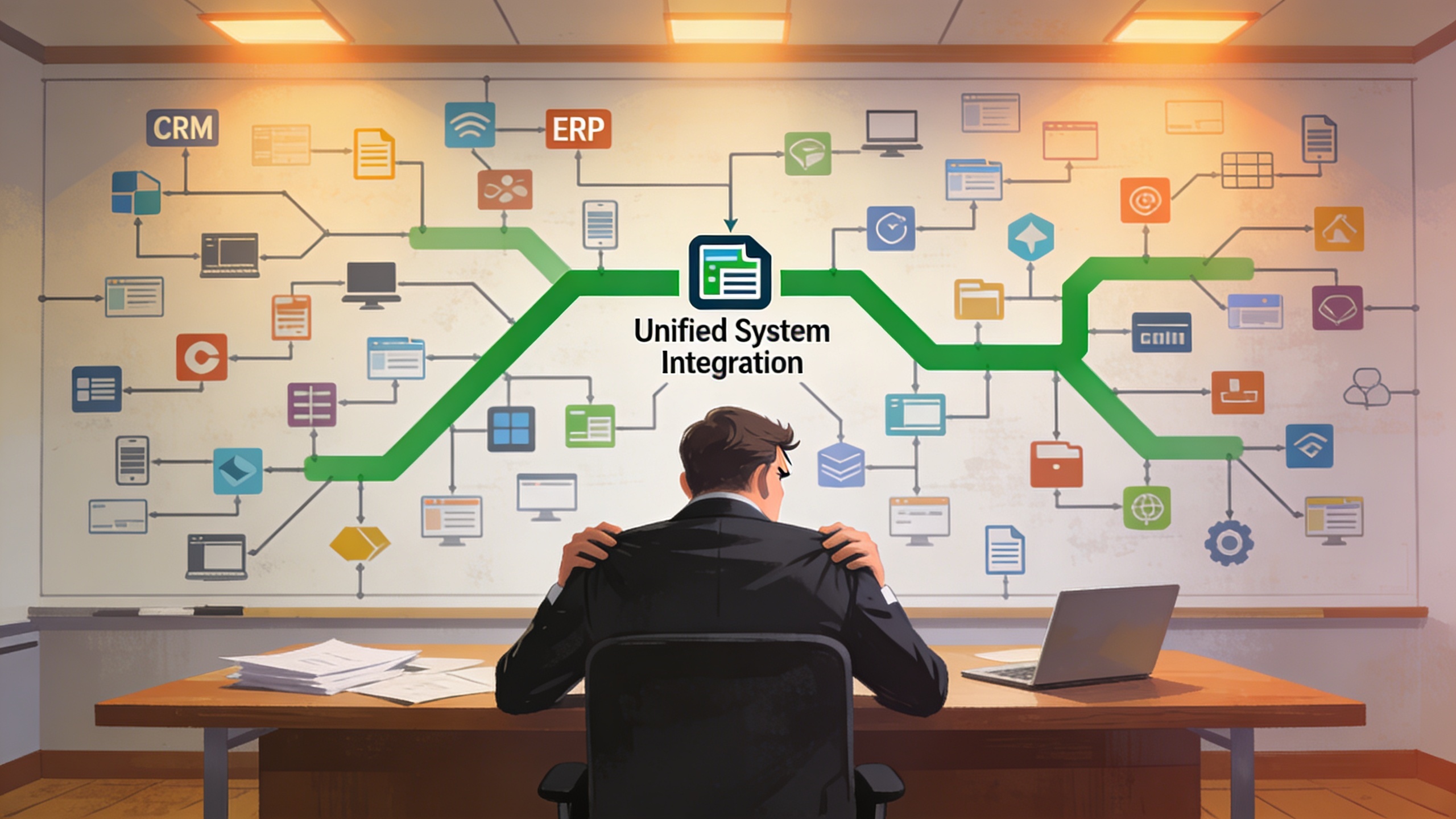
For example, the sales department says, “We want to streamline deal management,” and the accounting department says, “We want to automate billing.” They each introduce separate tools. At first glance, both seem right. But if these tools don’t integrate and data becomes fragmented, management can’t get an accurate picture of the overall situation.
This is a state where IT’s purpose is “split” across departments. In this state, no matter how high-performance the tools are, it’s difficult to achieve results for the company as a whole.
The Three Drawbacks of “Purpose Function Fragmentation”
In IT investment, the thing to avoid most is “purpose function fragmentation.” This refers to a phenomenon where the criteria for the results expected from IT vary from department to department and person to person.
1. Data Silos
When sales, accounting, and manufacturing each use independent systems, data doesn’t integrate. As a result, management can’t make optimal decisions for the whole, like “Sales are growing, so why is inventory increasing?”
2. Accelerated Dependency on Specific Individuals
A situation where “Only A knows how to do this task” or “Only B can use this system” is evidence that IT is being operated in a person-dependent way. This happens because management has only set IT’s purpose as “improving individual work efficiency.” Originally, IT should be there to increase repeatability—ensuring “anyone can get the same result.”
3. Inability to Measure Investment Effectiveness
Even if you can measure partial effects like “sales productivity improved” or “accounting processing time decreased,” it’s difficult to measure how much that contributed to “increasing the company’s overall profit.” Why? Because a common purpose (purpose function) for “what the company as a whole wants to achieve” wasn’t defined from the start.
Three Steps for Management to Design “IT’s Purpose”
So, how should management design IT’s purpose? Here are the specific steps.
Step 1: Work Backwards from the “Business Strategy”
The purpose of IT investment should be determined by working backwards from the business strategy.
* **Strategy Example A**: “Next quarter, we’ll focus on acquiring new customers.”
* **IT’s Purpose**: Centrally manage prospect behavior data and strengthen collaboration between marketing and sales (introduce and integrate a CRM).
* **Strategy Example B**: “Maximize the LTV (customer lifetime value) of existing customers.”
* **IT’s Purpose**: Analyze customer purchase and inquiry history to suggest upsells and cross-sells at the optimal timing (introduce a BI tool).
In this way, once the business strategy is decided, the role required of IT naturally becomes clear.
Step 2: Organize Using the “Three IT Categories”
In this media, we classify IT into three categories: “Business IT,” “Management IT,” and “Administrative IT.” Management needs to organize which of these their company’s IT investment falls under.
* **Business IT**: IT directly linked to sales and growth (e.g., e-commerce sites, marketing automation).
* **Management IT**: IT that enhances management decision-making and repeatability (e.g., management dashboards, ERP).
* **Administrative IT**: IT for stable operations and cost management (e.g., accounting software, attendance management systems).
Many companies tend to invest only in “Administrative IT,” leaving investment in “Business IT” and “Management IT” thin. Management needs to consciously design this balance.
Step 3: Articulate the “End State”
Let go of the idea that “just introducing a system will fix things.” Define specifically “who,” “what,” and “how” will change, in language that even people on the ground can understand.
* **Bad example**: “Improve sales productivity.”
* **Good example**: “Enable everyone to share the status of deals in real-time, and eliminate monthly progress review meetings. This will increase the number of visits per salesperson from 20 to 30 per month.”
This “end state” becomes the evaluation criteria after the IT implementation.
If You Design the Purpose, Tool Selection Becomes Easy
Once the purpose is clear, tool selection becomes surprisingly easy.
If the purpose is “to centrally manage customer data,” the choice between Salesforce, HubSpot, or in-house development can be judged relatively clearly.
Conversely, if you decide to “just get a CRM” with a vague purpose, you’ll be swayed by vendor sales pitches or dazzled by the number of features, ending up with a system that no one uses.
Summary: “IT’s Purpose” Is the One Job Management Must Design
The success of IT investment doesn’t depend on tools or vendors. It depends on whether management has designed the purpose of “what they want IT to do.”
* If the purpose is designed, data will be integrated, dependency on individuals will be prevented, and investment effectiveness will be measurable.
* If the purpose is not designed, no matter how expensive the system, it will only create departmental “silos” and complicate management.
It’s time to move past the idea that “IT should be left to the experts.” IT is a management resource that management itself must define and design. Is your company’s IT investment truly starting from a “purpose”?

Comments